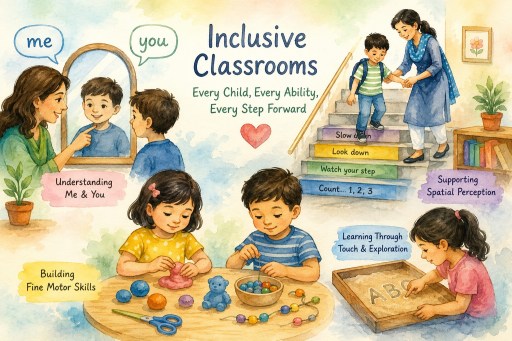
Montessori materials are grounded in a neurodevelopmental framework that leverages the brain’s plasticity during early childhood. Rather than being passive learning tools, they are intentionally designed sensory stimuli that engage multiple perceptual systems visual, tactile, auditory, proprioceptive, and vestibular at once. This multi-sensory engagement strengthens neural pathways responsible for organizing and interpreting environmental input.
The core mechanism lies in structured, repetitive, and self-correcting sensorimotor experiences. When children repeatedly manipulate materials, their nervous system practices integrating different streams of sensory data into a coherent perception of the world. This aligns with how the brain naturally learns through active interaction and feedback loops.
Such materials essentially help build “sensory coherence.” For example, when a child stacks objects or differentiates sounds, they are not just learning a concept but refining how their brain processes and integrates sensory input. Over time, this leads to improved attention, coordination, and adaptive responses. Thus, Montessori materials function as both educational and neurodevelopmental tools, shaping how children perceive and respond to their environment.

The principle of “isolation of difficulty” ensures that each Montessori material highlights only one sensory attribute at a time. For instance, the Pink Tower isolates size, while Sound Cylinders isolate auditory differences. By removing competing sensory variables like color or texture, the child can focus entirely on a single dimension.
This aligns with the brain’s computational strategy of forming precise internal models through clarity and repetition. When a stimulus is unambiguous, the brain can process it with greater accuracy and store it as a reliable “sensory standard.” These standards which help understand size, pitch, or texture become foundational building blocks for higher cognitive functions.
From a neurocognitive perspective, this method supports “reliability-weighted processing,” where clearer inputs are prioritized and encoded more strongly. It reduces cognitive overload and allows the child to master one concept before integrating multiple variables.
In essence, isolation of difficulty simplifies complexity without diluting learning. It mirrors how the brain naturally decomposes information into manageable units, making sensory integration more efficient and developmentally appropriate.

Montessori activities deeply engage the sensorimotor loop, which connects movement with sensory feedback. Tasks such as carrying materials, tracing shapes, or manipulating objects provide rich proprioceptive and tactile input. This feedback informs the brain about body position, force, and spatial relationships, helping build an accurate internal body map.
This development in the somatosensory cortex is crucial because motor, cognitive, and language systems are interlinked. Strong sensorimotor foundations enhance not only coordination but also problem-solving, attention, and communication skills. For example, tracing sandpaper letters while vocalizing sounds integrates touch, movement, and auditory processing—strengthening neural connections essential for literacy.
Empirical research supports this: studies and meta-analyses have shown that Montessori education positively impacts cognitive development, largely due to its emphasis on hands-on, experiential learning.
Thus, Montessori activities are not isolated exercises but integrated developmental experiences that bridge sensory processing with higher-order cognition.
For children with developmental delays or sensory processing differences, the Montessori approach offers a structured yet flexible therapeutic scaffold. Its predictability, repetition, and self-directed nature create a “just-right challenge,” avoiding both overstimulation and under-engagement.
Unlike more intensive clinical interventions, Montessori environments provide a naturalistic “sensory diet” of meaningful, organized experiences. Children can gradually build tolerance to sensory input while developing competence and confidence. The self-correcting nature of materials also promotes independence and reduces anxiety associated with external evaluation.
Research indicates that children with developmental delays show improvements in forming and applying sensory concepts through systematic use of Montessori materials. These gains are critical, as difficulties in sensory integration often underlie challenges in learning and behavior.
The inclusion of sensory play stations like water, sand, and textured exploration areas (as highlighted by Dhwani) also further supports sensory regulation. These activities allow children to modulate their sensory input in a controlled yet engaging way, promoting self-regulation and emotional stability.

How do Montessori materials support sensory integration in early childhood?
Montessori materials engage multiple senses—visual, tactile, auditory, proprioceptive, and vestibular—helping children organize and interpret sensory input more effectively.
Why are Montessori materials considered neurodevelopmental tools?
They are designed to strengthen neural pathways through hands-on, repetitive, and self-correcting activities that align with how the brain naturally learns.
What is meant by “sensory coherence”?
Sensory coherence refers to the brain’s ability to integrate different sensory inputs into a clear and meaningful understanding of the environment.
What is the principle of “isolation of difficulty”?
It means each Montessori material focuses on only one sensory attribute at a time, such as size or sound, to ensure clear and focused learning.
Why is isolating one concept important for sensory development?
It reduces confusion, improves accuracy in learning, and helps children build strong foundational sensory understanding.
How does this principle support brain development?
It allows the brain to process information clearly and store it as reliable sensory knowledge, supporting higher cognitive functions.
How do Montessori activities support sensorimotor development?
They connect movement with sensory feedback, helping children understand body position, coordination, and spatial awareness.
What role does the sensorimotor loop play in learning?
It links action and feedback, enabling children to refine their movements and improve cognitive and motor skills simultaneously.
Can Montessori activities improve cognitive skills?
Yes, they enhance attention, problem-solving, language development, and overall cognitive functioning through hands-on learning.
How does Montessori benefit children with sensory processing differences?
It offers structured, predictable, and flexible experiences that help children gradually adapt to sensory input at their own pace.
What is a “sensory diet” in Montessori?
It refers to regular exposure to meaningful sensory activities like water play, sand exploration, and textured materials.
How do Montessori environments support emotional regulation?
They provide calm, controlled sensory experiences that help children manage their responses and build emotional stability.
Why are self-correcting materials important?
They promote independence, reduce anxiety, and allow children to learn through their own exploration and mistakes.
Is Montessori effective for children with developmental delays?
Yes, research shows it helps improve sensory integration, concept formation, and overall learning outcomes.
Where can I buy books?
You can buy books at Bookosmia website’s Shop section and Amazon.
Where can I buy the book – Dhwani?
Dhwani is an inclusive, mindfulness-based initiative designed to support the emotional well-being of teachers and students while fostering truly inclusive classrooms. Rooted in research from education, psychology, and neuroscience, Dhwani recognizes a simple truth: regulated teachers create safe, inclusive learning spaces.
At its core, Dhwani focuses on self-regulation, awareness, and emotional literacy. The curriculum equips educators with practical tools—such as grounding exercises, breathing techniques, and reflective practices—that can be used in real classroom moments, not just in theory. These tools help teachers respond with curiosity rather than control, and empathy rather than assumption.
Dhwani believes inclusion is not a checklist or a one-time intervention, but an ongoing journey. By supporting teachers’ mental health, Dhwani helps reduce burnout, unpack unconscious bias, and build resilience—making inclusion sustainable rather than exhausting.
Through simple, age-appropriate practices, Dhwani also empowers students to understand their emotions, feel safe, and stay engaged, creating classrooms where every child is seen, valued, and supported.
In essence, Dhwani begins with the teacher’s well-being—because inclusion starts from within.
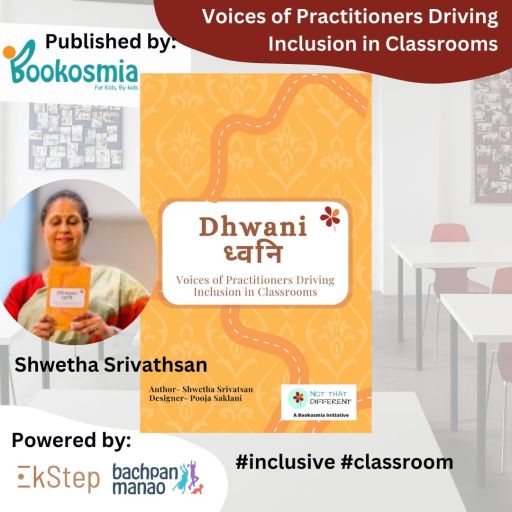
Dhwani I Voices of Practitioners Driving Inclusion in Classrooms
https://bookosmia.com/teachers-mental-health-inclusive-classrooms/


Gift Books On Inclusion — A package of 5 books on inclusion, empathy, and working together.
***
This article is published by Bookosmia, India’s #1 publisher for and by young people. Bookosmia publishes stories, books, podcasts, events, TED-Ed talks, workshops, bedtime stories and more related to kids and young adults.
Photo Credit – AI generated images from Chat GPT and Magic Media from Canva .
Want to publish your articles, reviews, stories, audio stories, bedtime stories and poems ?
Did you know that children can submit audio stories to be turned into Bedtime Stories and published on Bedtime Stories – A Podcast by Bookosmia?
Write to us at sara@bookosmia.com or submit your article at the link below
Read More
Understanding Sensory Differences in Neurodiverse Individuals