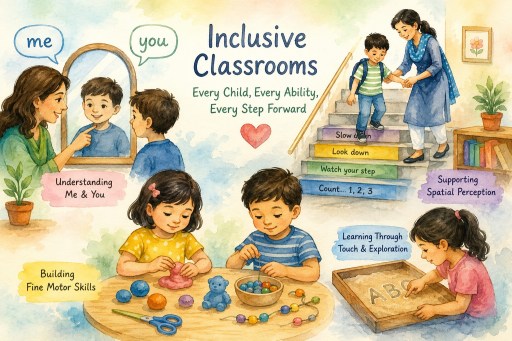
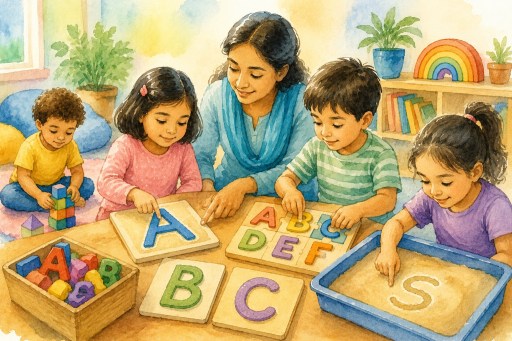
The Dhwani manual emphasizes that while a “village” is often cited as necessary to raise a child, it may take an “entire country” to support a child who is neurodiverse, necessitating a strong team approach between parents and teachers. Collaborative efforts are particularly crucial during Grades 1, 2, and 3, which Dhwani identifies as the years when differences often become more pronounced and require collaborative planning. To support skills like writing, teachers can provide strategies while encouraging parents to introduce activities at home—such as peeling vegetables, cutting fruit, or manipulating buttons and zippers—to build the necessary fine motor skills. Furthermore, Dhwani suggests that parents can introduce physical activities like swimming or cycling at home to improve the coordination and focus required for classroom tasks. For language development, Dhwani recommends that teachers send illustrated storybooks home as reading assignments, allowing parents to support the child’s receptive language skills before the teacher follows up the next day. This consistent reinforcement across both environments ensures that learning remains meaningful for the child.
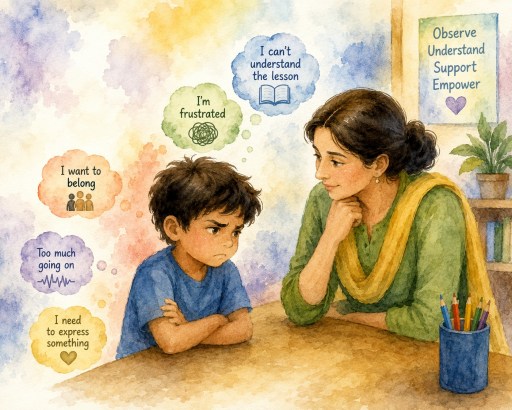
The Dhwani manual outlines a structured approach to “mastering the art of giving feedback” to ensure teachers are sensitive and empathetic when delivering difficult messages. Teachers should first observe and record the child’s behavior over time, as Dhwani notes that an intervention is only needed when there is a consistent pattern rather than a single “bad day”. When meeting with parents, the teacher should begin by highlighting the child’s strengths and the things they are able to do well. Dhwani advises teachers to remain objective, focusing the feedback on the specific challenge rather than the child’s character, and to use concrete instances rather than generalizations. Crucially, teachers should avoid using jargons, labels, or attempting to “diagnose” a child, as this is outside their professional scope. Finally, Dhwani encourages teachers to be active listeners, acknowledging the parents’ perspectives and learning how they handle similar challenges at home to create a unified plan for progress.

Inclusion in extra-curricular activities is vital because Dhwani recognizes these programs as the source of “core memories” that build confidence and social bonds. Successful inclusion requires a few “tweaks” and the ability for parents and teachers to work as a team. For instance, Dhwani recommends that if a specific costume is required for a performance, teachers should inform parents well in advance so they can help the child get used to the texture and feel of the clothing at home. Teachers can also seek parental help to modify field trips or excursions, such as allowing a parent to accompany the child or having the parent drop the student off directly at the venue to reduce transition stress. Special educator Puja Sood, a contributor to Dhwani, highlights that labeling a child is only useful if it helps teachers and parents work more
effectively together to focus on the student’s unique needs. By collaborating, parents and practitioners can spot a child’s hidden talents—such as an interest in music or art—and provide the stage experience needed to build lifelong confidence

What is the Dhwani manual?
The Dhwani manual is a guide that helps parents, teachers, and educators support neurodiverse children through inclusive and collaborative practices.
Why is parent-teacher collaboration important for neurodiverse children?
Consistent support at home and school helps children develop academic, social, communication, and life skills more effectively.
How can parents support foundational skills at home?
Parents can encourage activities such as reading, swimming, cycling, buttoning clothes, and simple household tasks to build motor and language skills.
How should teachers discuss learning challenges with parents?
Teachers should focus on the child’s strengths, use specific examples, avoid labels, and work with parents to create practical solutions.
Why are extracurricular activities important for neurodiverse students?
They help build confidence, social connections, creativity, and memorable learning experiences beyond the classroom.
How can schools make events more inclusive?
By planning ahead, making reasonable accommodations, and collaborating with families to meet each child’s unique needs.
What is the key message of the Dhwani manual?
Every child can thrive when parents, teachers, and educators work together with empathy, understanding, and a strengths-based approach.
Where can I buy books?
You can buy books at Bookosmia website’s Shop section and Amazon.
Where can I buy the book – Dhwani?
Dhwani is an inclusive, mindfulness-based initiative designed to support the emotional well-being of teachers and students while fostering truly inclusive classrooms. Rooted in research from education, psychology, and neuroscience, Dhwani recognizes a simple truth: regulated teachers create safe, inclusive learning spaces.
At its core, Dhwani focuses on self-regulation, awareness, and emotional literacy. The curriculum equips educators with practical tools—such as grounding exercises, breathing techniques, and reflective practices—that can be used in real classroom moments, not just in theory. These tools help teachers respond with curiosity rather than control, and empathy rather than assumption.
Dhwani believes inclusion is not a checklist or a one-time intervention, but an ongoing journey. By supporting teachers’ mental health, Dhwani helps reduce burnout, unpack unconscious bias, and build resilience—making inclusion sustainable rather than exhausting.
Through simple, age-appropriate practices, Dhwani also empowers students to understand their emotions, feel safe, and stay engaged, creating classrooms where every child is seen, valued, and supported.
In essence, Dhwani begins with the teacher’s well-being—because inclusion starts from within.
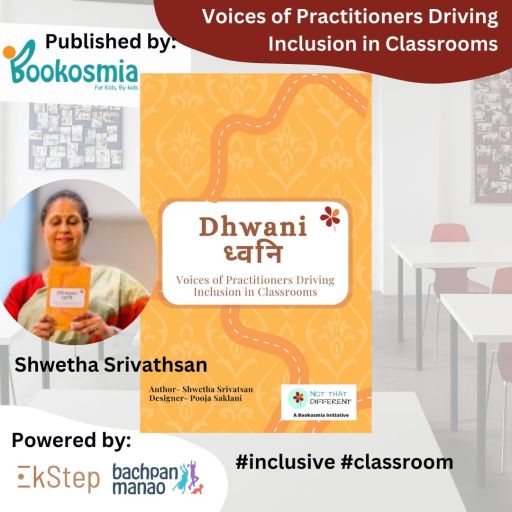
Dhwani I Voices of Practitioners Driving Inclusion in Classrooms
This article is published by Bookosmia, India’s #1 publisher for and by young people. Bookosmia publishes stories, books, podcasts, events, TED-Ed talks, workshops, bedtime stories and more related to kids and young adults.
Photo Credit – AI generated images from Chat GPT and Magic Media from Canva .
Want to publish your articles, reviews, stories, audio stories, bedtime stories and poems ?
Did you know that children can submit audio stories to be turned into Bedtime Stories and published on Bedtime Stories – A Podcast by Bookosmia?
Write to us at sara@bookosmia.com or submit your article at the link below
Read More