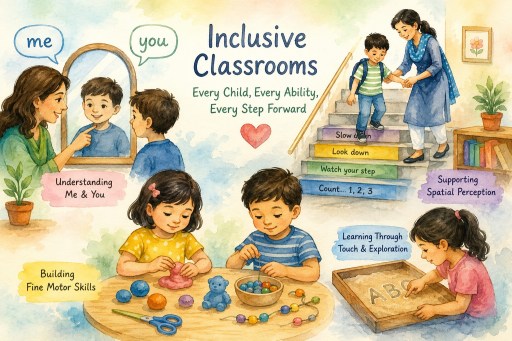
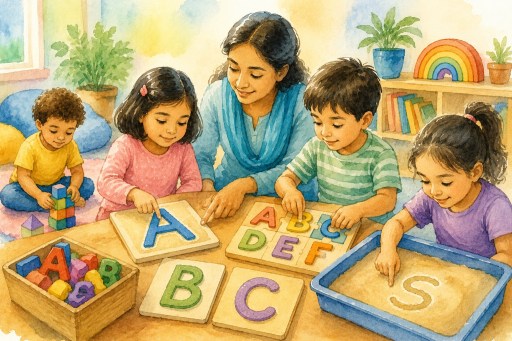
To ensure that the school Annual Day is inclusive, educators should focus on making meaningful tweaks to the program rather than viewing inclusion as a “rocket science” challenge. One primary method is to modify the choreography of performances; teachers can tweak the steps of a dance to include movements that can be easily performed by all children, specifically supporting those who may struggle to imitate complex or specific movements.
Additionally, sensory management is critical. For students with noise sensitivity, the sources suggest a simple but effective accommodation: allowing the child to go on stage with headphones on to manage the auditory environment while still participating in the collective experience. Furthermore, inclusion can be fostered by planning specific roles or programs that do not mandate the use of restrictive or uncomfortable costumes. Since many neurodivergent children struggle with the tactile experience of certain fabrics or the psychological pressure of dressing up, providing roles that allow for standard or comfortable clothing ensures they can focus on the performance rather than sensory distress.

The preparation phase is often more stressful than the performance itself for neurodivergent students. To mitigate this, schools should structure practice time with high precision. As mentioned in Dhwani, it is highly beneficial to allow a neurodivergent child to remain in a quiet space within the school until it is exactly her turn to practice, rather than requiring her to wait in a loud, crowded rehearsal area.
On the actual day of the performance, the sources emphasize reducing the time a neurodivergent student spends in high-stimulation environments like backstage or the green room. Unlike their neurotypical peers, these students should not be forced to arrive early at the venue; instead, teachers should work as a team with parents to coordinate a “just-in-time” arrival. This targeted approach helps preserve the child’s sensory energy for the performance itself. By seeking parents’ help as partners, schools can create a supportive team dynamic that prioritizes the child’s comfort and confidence over rigid adherence to traditional rehearsal schedules.

Field trips and excursions present unique challenges due to the lack of a familiar routine and the unpredictable nature of new environments. To bridge this gap, educators should stick visual cues and communication boards at the venue. These tools provide the student with a predictable way to understand the schedule and express their needs—such as wanting “more,” needing “help,” or signaling they are “finished”—in an environment that might otherwise feel overwhelming.
Furthermore, flexibility in logistics is a cornerstone of successful inclusion for off-campus activities. The sources suggest exploring options where a child is dropped off and picked up directly at the venue by their parent, rather than having to navigate the transition of a school bus. In some cases, it may even be necessary for a parent to accompany the child on the trip to provide one-on-one support. This collaborative effort between the school and home ensures that the child can participate in the bonding and skill-building aspects of the trip while having their differential needs met by someone who understands their sensory profile intimately.
When planning for Sports Day, the focus should shift from high-stakes competition to inclusive participation. As mentioned in Dhwani, schools should prioritize non-competitive sports and design games and activities that are inherently easy for all children to engage in, regardless of their athletic or motor skill level. This approach ensures that the day remains a source of core memories and confidence building rather than a source of frustration or exclusion.
Regarding the challenge of costumes, which are common in many extracurricular events, proactive communication is essential. If a specific costume is absolutely required for a role, teachers must inform parents well in advance. This lead time allows parents to help the child “habituate” to the garment by having them wear it for a short period every day at home until the child becomes accustomed to the sensation of the fabric. By facilitating this gradual exposure, the school and parents work together to ensure that the child’s sensory profile is respected while still allowing them to be a full participant in the school’s social and cultural life.
This article is written by Akshita Yadav. She is an 18-year-old undergraduate student from Nagpur, currently pursuing a Bachelor of Business Administration (BBA) at the Indian Institute of Management Bodhgaya (IIMBG). She has a keen interest in public policy and strategy, with a particular focus on neurodiversity and allied social policy domains. Akshita aspires to work in policy research and contribute to the nation’s think tanks through policy notes, strategic analysis, and inclusive governance frameworks
Schools can simplify choreography, allow sensory accommodations like headphones, and provide comfortable costume options for neurodivergent students.
Quiet spaces help reduce sensory overload and anxiety, allowing neurodivergent students to practice comfortably and confidently.
Schools can use visual aids, communication boards, and collaborate with parents for flexible travel and support arrangements.
Parents can help educators understand the child’s sensory needs and provide support during events, practices, and excursions
Schools can focus on non-competitive games and activities that encourage participation from all students.
Early communication allows children time to gradually adjust to costumes and feel comfortable before the event.
They help students express needs such as asking for help, requesting breaks, or understanding schedules in unfamiliar settings.
Flexible schedules and accommodations reduce stress and allow students to participate in activities more successfully.
Dhwani is an inclusive, mindfulness-based initiative designed to support the emotional well-being of teachers and students while fostering truly inclusive classrooms. Rooted in research from education, psychology, and neuroscience, Dhwani recognizes a simple truth: regulated teachers create safe, inclusive learning spaces.
At its core, Dhwani focuses on self-regulation, awareness, and emotional literacy. The curriculum equips educators with practical tools—such as grounding exercises, breathing techniques, and reflective practices—that can be used in real classroom moments, not just in theory. These tools help teachers respond with curiosity rather than control, and empathy rather than assumption.
Dhwani believes inclusion is not a checklist or a one-time intervention, but an ongoing journey. By supporting teachers’ mental health, Dhwani helps reduce burnout, unpack unconscious bias, and build resilience—making inclusion sustainable rather than exhausting.
Through simple, age-appropriate practices, Dhwani also empowers students to understand their emotions, feel safe, and stay engaged, creating classrooms where every child is seen, valued, and supported.
In essence, Dhwani begins with the teacher’s well-being—because inclusion starts from within.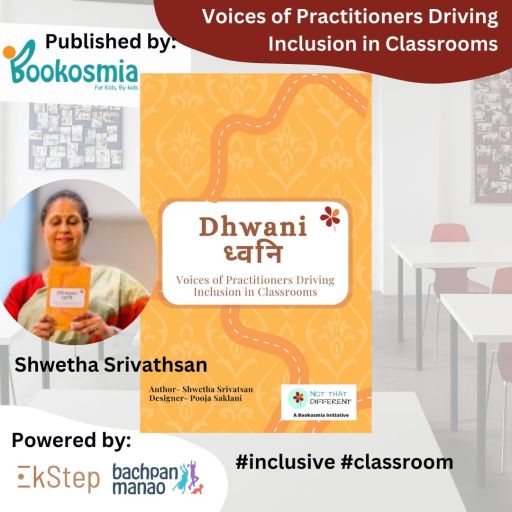
Dhwani I Voices of Practitioners Driving Inclusion in Classrooms

Gift Books On Inclusion
₹999
***
This article is published by Bookosmia, India’s #1 publisher for and by young people. Bookosmia publishes stories, books, podcasts, events, TED-Ed talks, workshops, bedtime stories and more related to kids and young adults.
Photo Credit – AI generated images from Chat GPT and Magic Media from Canva .
Want to publish your articles, reviews, stories, audio stories, bedtime stories and poems ?
Did you know that children can submit audio stories to be turned into Bedtime Stories and published on Bedtime Stories – A Podcast by Bookosmia?
Write to us at sara@bookosmia.com or submit your article at the link below
Read More