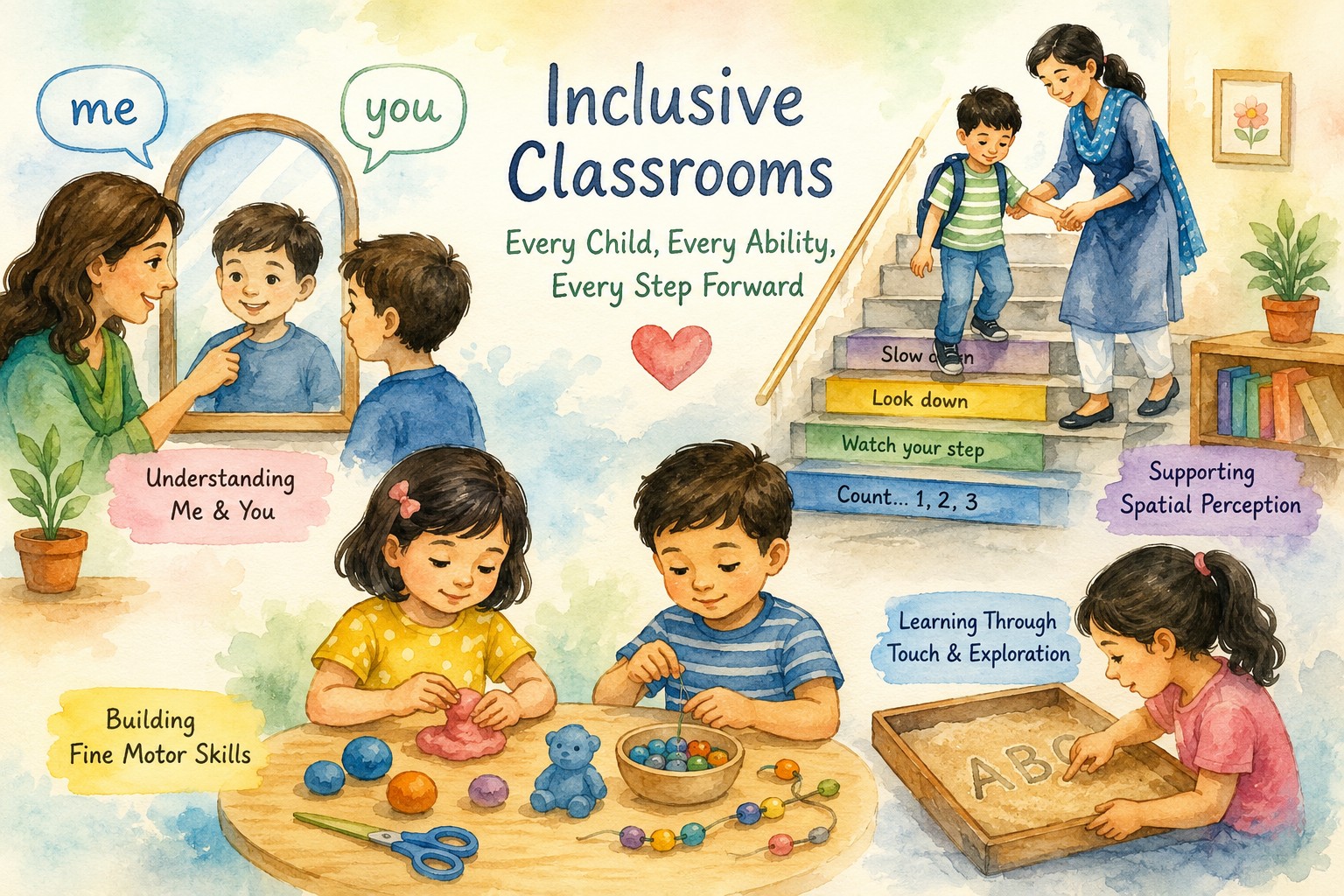
The strategic value of inclusive education is often found in “small tweaks” that dramatically reduce the “sensory tax” levied on a neurodivergent child. These subtle adjustments in content delivery and environmental design are the mechanisms that transform a daily struggle into a meaningful, joyful learning experience. By making minor modifications—such as changing how an instruction is phrased or introducing tactile materials—the educator removes the friction from the student’s path, allowing their cognitive resources to be redirected toward actual discovery and growth. These applied strategies are not just classroom management techniques; they are the evidence-based tools that unlock a child’s social agency and academic confidence, proving that the most effective systemic changes often begin with the most nuanced observations of an individual student’s needs.
For students like “Megha” who struggle with the abstract linguistic nature of pronouns, we utilize a sequential five-step strategy to ground these concepts.
First, we use a mirror to provide a constant physical reference for the self (“me”) and the other (“you”).
Second, the educator must temporarily strip pronouns from instructions—changing “give it to me” to “give the ball”—to ensure the core action is mastered first.
Third, we gradually reintroduce pronouns in a controlled manner while still using the mirror for reinforcement.
Fourth, the practitioner asks the child strategic questions: “When you talk about yourself, which word will you use?” We then use the child’s response as a cue for gentle, immediate reiteration and correction.
Finally, once the primary “me/you” distinction is clear, we extend the practice to more complex pronouns. This methodical breakdown ensures that the child builds a foundation of social agency, allowing them to navigate personal relationships with linguistic clarity and confidence.
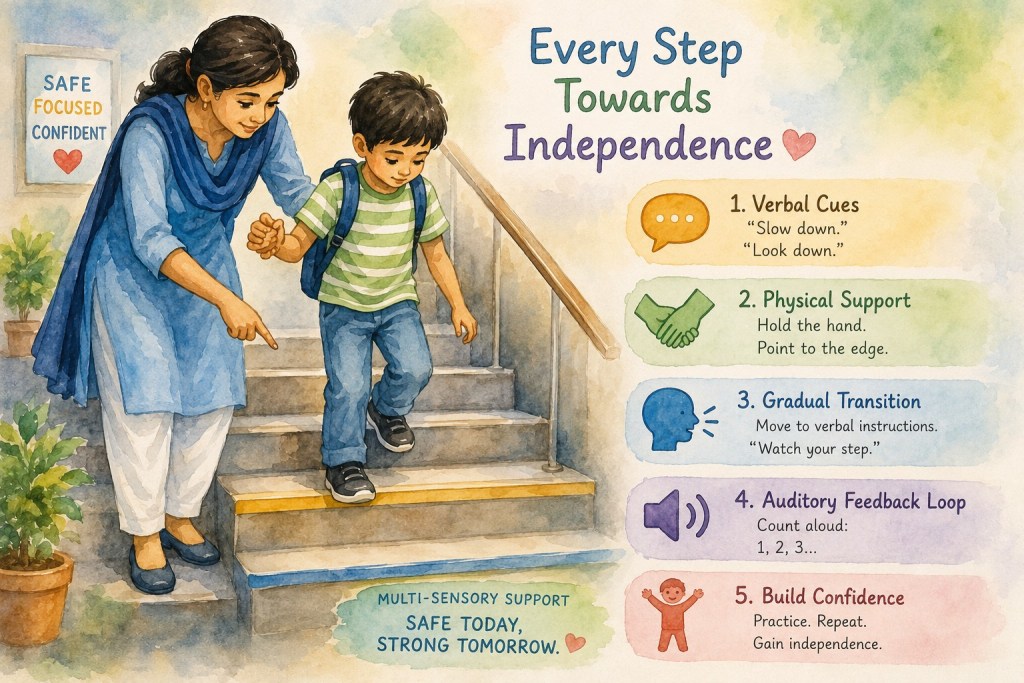
Students like “Atharva” often face significant anxiety when navigating the physical environment because their brain struggles to process spatial depths, such as the edge of a step. To assist, the educator provides a multi-sensory “scaffolding” process. We begin with consistent verbal cues to “slow down” and “look down,” helping the child consciously focus their visual attention. In the initial stages, the teacher should hold the student’s hand for the first few steps while physically pointing to the edge of the stair. As the child gains confidence, we transition to purely verbal instructions—”watch your step”—while still providing a visual point of reference. A highly effective strategic layer is the “auditory feedback loop”: teaching the child to count aloud as they ascend or descend. This vocalization forces the child to slow their physical pace, giving their brain the necessary time to process the visual information and navigate the environment safely and with increasing independence.
In the early inclusive classroom, we prioritize fine motor development—clay modeling, beading, sorting, and scissor work—because academic confidence is built on a foundation of physical readiness. If a child’s hand lacks the intrinsic strength to manipulate a pencil, forcing the complex task of alphabet formation will only lead to frustration and a sense of inadequacy. By focusing on “pre-writing” motor tasks, we ensure the child has the physical mastery required for eventual success. The strategic significance of this approach is its extension into the home; we encourage parents to involve children in daily activities like peeling vegetables, zipping jackets, and tying shoe laces. This transforms every domestic task into a motor skill exercise. When we treat writing as the final milestone of a longer developmental arc rather than the starting point, we protect the child’s self-esteem and ensure that when they finally pick up a pencil, they are physically and emotionally ready to succeed.

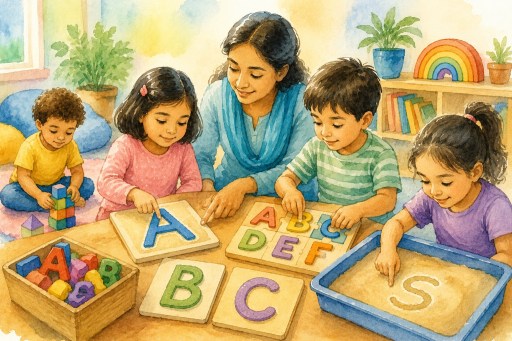
Universal Design for Learning (UDL) is executed by providing multiple pathways for a student to engage with the same information. In a “sensory smart” classroom, we move beyond visual flashcards to incorporate tactile materials like sandpaper alphabets and alphabet puzzles. This allows a child to “feel” the shape of a letter, providing a multi-sensory reinforcement that visual instruction alone lacks. A vital tool in this framework is the sand tray; by allowing a student to spend hours making shapes and letters in the sand, we provide a low-pressure, high-tactile environment for exploration. This reduces the performance anxiety often associated with paper and pen. These simple accommodations—puzzles, textured letters, and sand trays—ensure that a student’s sensory profile is treated as a strength rather than a barrier. By providing these tactile options, the educator accommodates the diverse ways human brains process information, ensuring that every student, regardless of their neurotype, has a direct pathway to academic mastery.
Ultimately, the power to unlock learning resides with the teacher, whose daily commitment to inclusion creates a society where everyone, regardless of their neurotype, has a valuable and recognized role to play, as championed by Aditi Sowmyanarayan.
Teachers can use a mirror to create a clear visual reference for “me” and “you.” Initially, instructions can avoid pronouns—for example, saying “give the ball” instead of “give it to me.” Once the child understands the action, pronouns can be gradually reintroduced through simple questions and repetition.
A mirror provides a concrete visual reference for the child and the person they are interacting with. It helps make the otherwise abstract concepts of “me” and “you” easier to understand through repeated visual and verbal association.
Teachers can use consistent verbal and visual cues such as “slow down,” “look down,” and “watch your step.” Initially, physical guidance may be provided when appropriate, followed by verbal guidance as the child becomes more confident and independent.
Counting aloud can create an auditory feedback loop that encourages the child to slow down and pay attention to each step. This gives the child additional time to process visual and spatial information while moving.
Writing requires considerable hand strength, coordination, and control. Activities such as clay modeling, beading, sorting, and cutting help develop these foundational skills. Once children have greater physical readiness, writing can become less frustrating and more manageable.
Parents can incorporate motor practice into daily routines through activities such as peeling vegetables, zipping jackets, tying shoelaces, sorting objects, opening containers, and playing with clay.
Universal Design for Learning, or UDL, is an approach that provides multiple ways for students to engage with information and demonstrate learning. It recognizes that children have different learning and sensory needs and provides flexible pathways to participation.
Teachers can use sandpaper letters, alphabet puzzles, sand trays, textured objects, clay, and other tactile learning materials. These resources allow children to explore concepts through touch and movement as well as through visual instruction.
A sand tray provides a low-pressure, tactile environment where children can experiment with shapes, patterns, numbers, and letters. It can make early writing and learning activities more exploratory and less focused on performance.
Sensory-friendly materials can reduce barriers to learning for children who process information differently. They provide alternative ways to interact with concepts and can help children use their individual sensory strengths to participate more confidently.
No. Inclusive strategies can benefit the entire classroom. Providing different ways to learn, communicate, move, and participate gives every child opportunities to engage according to their strengths.
Teachers can begin with appropriate levels of physical, visual, or verbal assistance and gradually reduce that support as the child develops confidence and competence. The goal is not permanent assistance but increasing independence.
Small adjustments can remove unnecessary barriers that consume a child’s attention and energy. When those barriers are reduced, children can devote more cognitive and emotional resources to learning, exploration, communication, and social participation.
The goal is to create an environment where every child can participate meaningfully, develop confidence, and access learning in ways that suit their individual strengths and needs. Inclusion is ultimately about ensuring that every child feels valued and has a recognized role in the classroom and wider community.
Where can I buy books?
You can buy books at Bookosmia website’s Shop section and Amazon.
Where can I buy the book – Dhwani?
Dhwani is an inclusive, mindfulness-based initiative designed to support the emotional well-being of teachers and students while fostering truly inclusive classrooms. Rooted in research from education, psychology, and neuroscience, Dhwani recognizes a simple truth: regulated teachers create safe, inclusive learning spaces.
At its core, Dhwani focuses on self-regulation, awareness, and emotional literacy. The curriculum equips educators with practical tools—such as grounding exercises, breathing techniques, and reflective practices—that can be used in real classroom moments, not just in theory. These tools help teachers respond with curiosity rather than control, and empathy rather than assumption.
Dhwani believes inclusion is not a checklist or a one-time intervention, but an ongoing journey. By supporting teachers’ mental health, Dhwani helps reduce burnout, unpack unconscious bias, and build resilience—making inclusion sustainable rather than exhausting.
Through simple, age-appropriate practices, Dhwani also empowers students to understand their emotions, feel safe, and stay engaged, creating classrooms where every child is seen, valued, and supported.
In essence, Dhwani begins with the teacher’s well-being—because inclusion starts from within.
Dhwani I Voices of Practitioners Driving Inclusion in Classrooms
This article is published by Bookosmia, India’s #1 publisher for and by young people. Bookosmia publishes stories, books, podcasts, events, TED-Ed talks, workshops, bedtime stories and more related to kids and young adults.
Photo Credit – AI generated images from Chat GPT and Magic Media from Canva .
Want to publish your articles, reviews, stories, audio stories, bedtime stories and poems ?
Did you know that children can submit audio stories to be turned into Bedtime Stories and published on Bedtime Stories – A Podcast by Bookosmia?
Write to us at sara@bookosmia.com or submit your article at the link below
Read More