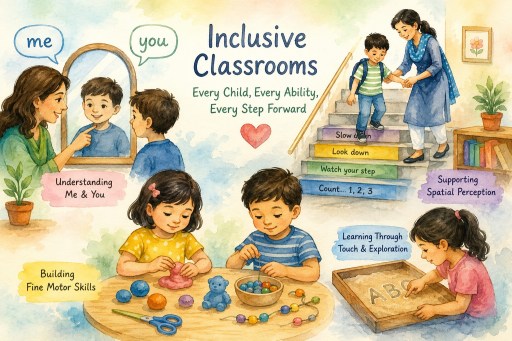
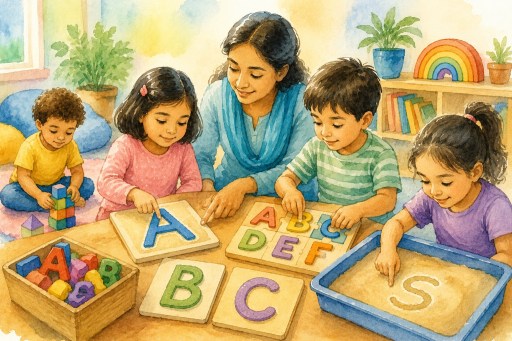
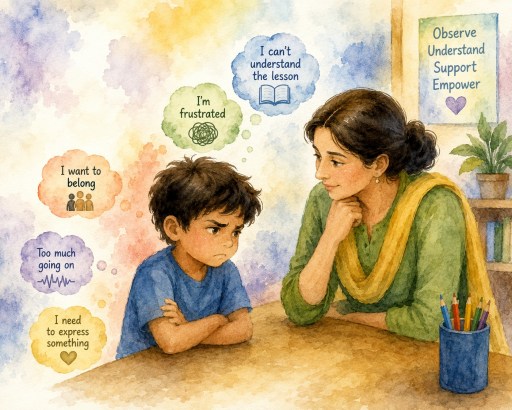
Accommodations are simple tweaks to content, delivery or the physical environment that help diverse learners succeed to the best of their ability. They are not meant to change “how” you teach but rather to act as a bridge to ensure information is accessible.
These adjustments often follow the Universal Design for Learning (UDL) framework which operates on three tenets:
Providing multiple means of representation, expression and engagement. For example, a concept like “parts of a plant” can be taught using a real plant a labeled picture or an interactive app.
In a sensory-smart classroom, accommodations might include using neutral wall colors to reduce visual distraction or providing fidget toys to help students manage restlessness. Teachers might also use visual schedules with pictures to help students anticipate daily routines which significantly reduces anxiety.
AI supports inclusive learning by helping teachers create materials tailored to diverse learning needs quickly and efficiently. By using well-designed prompts, teachers can generate differentiated worksheets audio lessons and visually organized tools like mind maps and T-charts suited to various cognitive levels.
AI enables multiple versions of the same topic, ensuring that learners at different ability levels engage meaningfully. It also helps design alternative assessments so students can demonstrate understanding in ways aligned with their strengths. Additionally AI can guide teachers on sensory preferences and optimal delivery modes, making classrooms more flexible, personalized and accessible for neurodivergent and diverse learners.
Inclusive strategies must evolve as a child grows, spanning from pre-school to primary years and even into extracurricular activities.
● Pre-School (Ages 2.5–6): For young children, teachers may model simple one-step instructions or use social stories to help them understand personal space. If a child struggles with “pronoun reversal” (confusing ‘you’ and ‘me’), a teacher might use gestures or a mirror to reiterate the concept.
● Primary School (Ages 6–9): At this stage, academics become more complex. Accommodations include offering audio recordings of text, allowing students to type answers instead of writing them, or using multiple-choice questions for assessments. For math, using manipulatives like number rods or spindle boxes helps bridge the gap between concrete and abstract understanding.
● Extra-Curricular Activities: Inclusion extends to the stage and the field. This might mean tweaking dance steps so all children can participate, allowing students with noise sensitivity to wear noise-canceling headphones on stage, or providing flexible arrival times for school events to reduce sensory overload.
In India, inclusive education is not just a choice; it is a mandatory legal requirement governed by the Rights of Persons with Disabilities (RPwD) Act, 2016. Section 17 of this Act mandates that the government and educational institutions ensure inclusive education for all children with disabilities.
Key legal requirements include:
● Providing reasonable accommodations to support academic and social development.
● Teaching in the most appropriate languages and communication methods for the child.
● Ensuring equal access to sports and recreation.
The National Education Policy (NEP) 2020 further strengthens this by emphasizing equitable education for all. The NEP recommends adapting the curriculum to meet individual needs and mandates continuous teacher training to help educators implement these flexible strategies. It also proposes Special Educational Zones for regions with large populations of students with special needs. By following these frameworks, schools ensure that students with disabilities can complete their foundational and secondary schooling alongside their peers.
This Blog is written by Akshita Yadav
Akshita Yadav is an 18-year-old undergraduate student from Nagpur, currently pursuing a Bachelor of Business Administration (BBA) at the Indian Institute of Management Bodhgaya (IIMBG). She has a keen interest in public policy and strategy, with a particular focus on neurodiversity and allied social policy domains. Akshita aspires to work in policy research and contribute to the nation’s think tanks through policy notes, strategic analysis, and inclusive governance frameworks.
What are accommodations in education?
Accommodations are adjustments in teaching methods, assessments, or the classroom environment that help students access learning fairly without changing the curriculum goals.
Are accommodations the same as modifications?
No. Accommodations change how a student learns or shows understanding, while modifications change what a student is expected to learn.
Who is eligible for accommodations?
Students with diagnosed disabilities, learning differences, or specific educational needs may be eligible, usually supported by documentation from qualified professionals.
What legal framework supports inclusive education in India?
The Rights of Persons with Disabilities Act mandates inclusive education, and the National Education Policy strengthens equitable learning practices.
What accommodations does CBSE provide?
The Central Board of Secondary Education offers extra time, scribe facilities, subject exemptions, and flexibility in evaluation for eligible students.
Does NIOS provide flexible learning options?
Yes. The National Institute of Open Schooling offers on-demand exams, flexible subject choices, assistive devices, and extended time.
Can technology help in providing accommodations?
Yes. Tools like text-to-speech software, audiobooks, visual organizers and AI-based resources help personalize learning and improve accessibility.
How often should accommodations be reviewed?
Accommodations should be reviewed regularly, typically once a year or when a student’s needs change to ensure they remain appropriate and effective.
Where can I buy books?
You can buy books at Bookosmia website’s Shop section and Amazon.
Here are some related books (on teamwork, friendship) that you can buy:
Where can I buy the book – Dhwani?
Dhwani is an inclusive, mindfulness-based initiative designed to support the emotional well-being of teachers and students while fostering truly inclusive classrooms. Rooted in research from education, psychology, and neuroscience, Dhwani recognizes a simple truth: regulated teachers create safe, inclusive learning spaces.
At its core, Dhwani focuses on self-regulation, awareness, and emotional literacy. The curriculum equips educators with practical tools—such as grounding exercises, breathing techniques, and reflective practices—that can be used in real classroom moments, not just in theory. These tools help teachers respond with curiosity rather than control, and empathy rather than assumption.
Dhwani believes inclusion is not a checklist or a one-time intervention, but an ongoing journey. By supporting teachers’ mental health, Dhwani helps reduce burnout, unpack unconscious bias, and build resilience—making inclusion sustainable rather than exhausting.
Through simple, age-appropriate practices, Dhwani also empowers students to understand their emotions, feel safe, and stay engaged, creating classrooms where every child is seen, valued, and supported.
In essence, Dhwani begins with the teacher’s well-being—because inclusion starts from within.
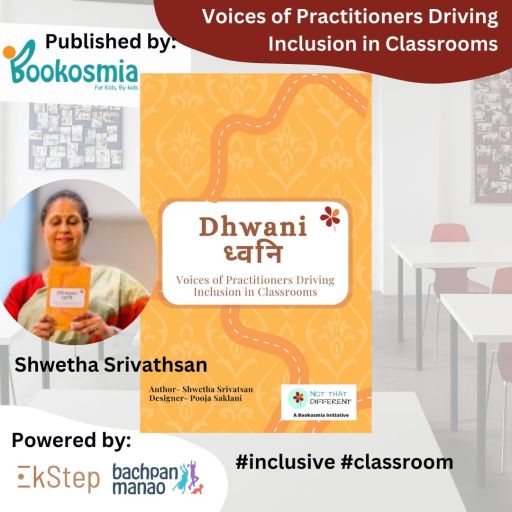
Dhwani I Voices of Practitioners Driving Inclusion in Classrooms
https://bookosmia.com/teachers-mental-health-inclusive-classrooms/


Gift Books On Inclusion — A package of 5 books on inclusion, empathy, and working together.
***
This article is published by Bookosmia, India’s #1 publisher for and by young people. Bookosmia publishes stories, books, podcasts, events, TED-Ed talks, workshops, bedtime stories and more related to kids and young adults.
Photo Credit – AI generated images from Chat GPT and Magic Media from Canva .
Want to publish your articles, reviews, stories, audio stories, bedtime stories and poems ?
Did you know that children can submit audio stories to be turned into Bedtime Stories and published on Bedtime Stories – A Podcast by Bookosmia?
Write to us at sara@bookosmia.com or submit your article at the link below
Read More
Sensory-Friendly Classroom Setup: Tips for Inclusive Education