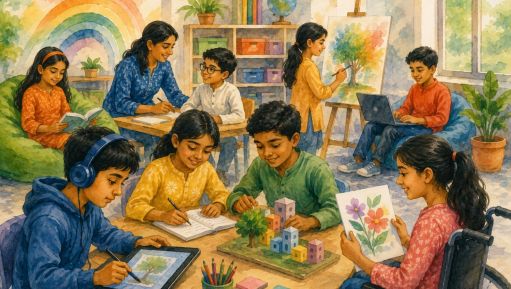
The school playground operates very differently from the classroom. It is unstructured, child-driven, and socially dynamic, making it a powerful space for authentic inclusion. Unlike classrooms, where interactions are guided and regulated, playgrounds allow children to choose how, when, and with whom they engage. This element of agency is critical—because inclusion becomes a lived experience rather than a mandated activity.
Playgrounds naturally combine intrinsic motivation (play), social complexity, and freedom of interaction. Children are not participating because they are instructed to, but because they want to. This makes social engagement more genuine. For neurodivergent (ND) children, this creates opportunities to engage at their own pace, observe others, and gradually participate without the pressure of formal expectations.
Thus, the playground becomes a space where inclusion is not structured or forced, but organically experienced through shared play, making it more meaningful and sustainable.
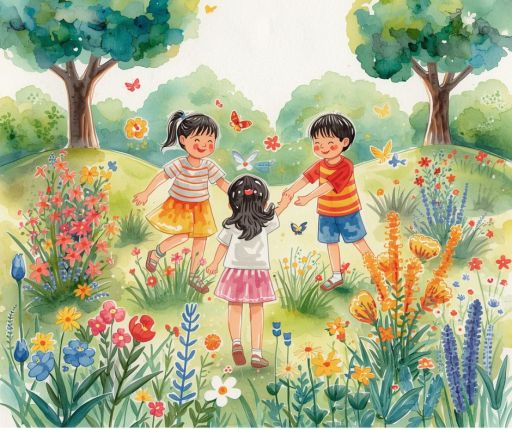
The unstructured nature of playgrounds creates what can be understood as a “zone of tolerable challenge.” ND children often find such environments difficult because they involve unpredictable social cues, changing rules, and sensory stimuli. However, this very challenge becomes a mechanism for growth.
Through repeated exposure to play situations, ND children begin to:
● Practice initiating interactions
● Learn to interpret social cues
● Engage in negotiation and cooperation
Unlike classrooms, where mistakes may feel evaluative, playgrounds offer a low-stakes environment where children can try, fail, withdraw, and re-engage. This flexibility supports both emotional regulation and social learning.
Additionally, playgrounds allow ND children to participate through their strengths. For instance, a child may contribute through creativity, structured thinking, or deep knowledge of a topic during play. Over time, this builds confidence and fosters a sense of belonging.
Importantly, when the environment includes sensory-sensitive elements (like quieter areas or varied levels of activity), it allows ND children to regulate themselves and re-enter play when ready. This supports not just social development, but also emotional resilience and self-awareness.
The playground also plays a crucial role in shaping how neurotypical (NT) children perceive and respond to difference. Through regular, informal interaction, NT children are exposed to diverse behaviours in a natural setting. This often leads to curiosity—questions like “Why does she play differently?” or “Why does he need space?”
Such questions are important because they initiate understanding rather than judgment. Through observation and shared play:
● Differences become normalized rather than stigmatized
● Fear or confusion is replaced with familiarity
● Children begin to develop more nuanced social awareness
When supported by adults who respond with clear and empathetic explanations, NT children learn to interpret behaviours through a neurodiversity-affirming lens. Over time, this fosters empathy and reduces exclusionary behaviour.
Moreover, shared play creates moments of equal participation. When children collaborate in games or activities, the focus shifts from differences to shared goals. This helps NT children see ND peers not as “different,” but as play partners, strengthening inclusive attitudes.

One of the most powerful aspects of playground inclusion is the emergence of organic peer support. Unlike formal buddy systems, these relationships develop naturally through repeated interaction.
This process typically unfolds in stages:
● Familiarity through proximity: Regular exposure reduces hesitation and builds comfort between children.
● Role-based interaction: In play, children adopt roles that suit their strengths—allowing ND children to contribute meaningfully.
● Spontaneous helping behaviour: NT children may begin by assisting—explaining rules, inviting participation, or mediating interactions.
● Development of reciprocity: Over time, these interactions evolve into mutual relationships, where both children benefit.
These organically formed bonds are particularly effective because they are self-motivated rather than assigned. The NT child develops a sense of purpose and empathy, while the ND child experiences genuine inclusion rather than structured support.
Such interactions also contribute to identity formation. NT children begin to see themselves as supportive peers, while ND children develop confidence in their social abilities. Over time, these relationships often extend beyond the playground, influencing classroom interactions and overall school culture.
This article is written by Akshita Yadav. She is an 18-year-old undergraduate student from Nagpur, currently pursuing a Bachelor of Business Administration (BBA) at the Indian Institute of Management Bodhgaya (IIMBG). She has a keen interest in public policy and strategy, with a particular focus on neurodiversity and allied social policy domains. Akshita aspires to work in policy research and contribute to the nation’s think tanks through policy notes, strategic analysis, and inclusive governance frameworks.

Why is the playground better for inclusion than a classroom?
The playground is unstructured and child-driven. Unlike the classroom, where interactions are often mandated by a teacher, playground socialising is based on intrinsic motivation. This makes inclusion a genuine “lived experience” rather than a forced academic exercise.
How does the playground help neurodivergent (ND) children grow?
It creates a “zone of tolerable challenge.” The unpredictable nature of play encourages ND children to practice social cues and cooperation in a low-stakes environment. Because there are no “grades” for play, children feel safer to try, fail, and re-engage.
What role does “agency” play in playground inclusion?
Agency allows children to choose the pace and intensity of their social interactions. For an ND child, having the freedom to observe from the sidelines before joining in—without being forced—is critical for building authentic confidence.
How do neurotypical (NT) children learn from these interactions?
Regular, informal exposure normalizes differences. Instead of seeing a peer as “different,” NT children develop curiosity. When they ask questions and engage, fear or confusion is replaced by familiarity and empathy.
What is “informal buddying”?
These are support systems that emerge organically rather than being assigned by adults. They start with simple proximity and evolve into mutual relationships where children help each other based on their unique strengths.
Can a playground actually improve emotional regulation?
Yes. By navigating “low-stakes” social mistakes and sensory stimuli, ND children practice self-awareness and resilience. Environments that offer “quiet zones” allow them to regulate and return to play when they are ready.
How does play change the way children see their peers?
Play shifts the focus from “disability” to “shared goals.” When children collaborate to build a fort or play a game, the ND child is seen as a valuable partner, which reduces stigmatization.
Do these playground relationships last?
Often, yes. Because these bonds are self-motivated, they frequently extend into the classroom. This improves the overall school culture and makes group work in academic settings much smoother.
How should adults intervene in playground play?
Adults should act as empathetic guides. Instead of over-regulating, they should provide clear explanations when NT children have questions, helping them view diverse behaviors through a neurodiversity-affirming lens.
How can playground design support inclusion?
By providing varied sensory environments (such as quiet areas, creative zones, and active spaces). This ensures that every child, regardless of their sensory needs, has a place where they feel comfortable enough to engage with others.
Where can I buy books?
You can buy books at Bookosmia website’s Shop section and Amazon.
Where can I buy the book – Dhwani?
Dhwani is an inclusive, mindfulness-based initiative designed to support the emotional well-being of teachers and students while fostering truly inclusive classrooms. Rooted in research from education, psychology, and neuroscience, Dhwani recognizes a simple truth: regulated teachers create safe, inclusive learning spaces.
At its core, Dhwani focuses on self-regulation, awareness, and emotional literacy. The curriculum equips educators with practical tools—such as grounding exercises, breathing techniques, and reflective practices—that can be used in real classroom moments, not just in theory. These tools help teachers respond with curiosity rather than control, and empathy rather than assumption.
Dhwani believes inclusion is not a checklist or a one-time intervention, but an ongoing journey. By supporting teachers’ mental health, Dhwani helps reduce burnout, unpack unconscious bias, and build resilience—making inclusion sustainable rather than exhausting.
Through simple, age-appropriate practices, Dhwani also empowers students to understand their emotions, feel safe, and stay engaged, creating classrooms where every child is seen, valued, and supported.
In essence, Dhwani begins with the teacher’s well-being—because inclusion starts from within.
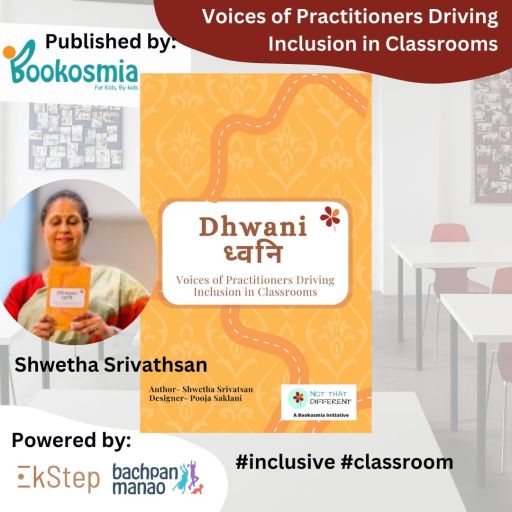
Dhwani I Voices of Practitioners Driving Inclusion in Classrooms
https://bookosmia.com/teachers-mental-health-inclusive-classrooms/

Gift Books On Inclusion — A package of 5 books on inclusion, empathy, and working together.
***
This article is published by Bookosmia, India’s #1 publisher for and by young people. Bookosmia publishes stories, books, podcasts, events, TED-Ed talks, workshops, bedtime stories and more related to kids and young adults.
Photo Credit – AI generated images from Chat GPT and Magic Media from Canva .
Want to publish your articles, reviews, stories, audio stories, bedtime stories and poems ?
Did you know that children can submit audio stories to be turned into Bedtime Stories and published on Bedtime Stories – A Podcast by Bookosmia?
Write to us at sara@bookosmia.com or submit your article at the link below
Read More
How to Implement the Dhwani Inclusion Manual: A Step-by-Step Guide for Inclusive Program Design