Dhwani’s guidance reflects the ethical and scientific boundary between educational observation and clinical diagnosis. Conditions such as Attention-Deficit/Hyperactivity Disorder (ADHD) and Autism Spectrum Disorder (ASD) are neurodevelopmental disorders defined by criteria in the DSM-5-TR and ICD-11. A valid diagnosis requires multi-informant, cross-setting assessment by licensed professionals (e.g., developmental pediatricians, clinical psychologists), integrating developmental history, standardized tools such as the ADOS-2, and evidence that symptoms are pervasive, persistent, and functionally impairing.
Teachers observe behavior in a single context—the classroom—which is insufficient for differential diagnosis. Labeling someone as “hyperactive” risks pathologizing normal variation, overlooking mimicking conditions (e.g., anxiety, trauma, sleep disturbance, hearing impairment), and triggering expectancy effects predicted by labeling theory. Research shows diagnostic labels can lower teacher expectations and shape self-concept. By stating, “Finish two sums, then take a short break,” the teacher uses objective, functional language aligned with Response to Intervention (RtI) and Universal Design for Learning (UDL), focusing on support rather than stigma.
Language in classrooms directly shapes expectations, access to support, and students’ developing identities. Clinical labels such as ADHD or ASD denote complex neurodevelopmental conditions requiring comprehensive, cross-context evaluation under DSM-5-TR or ICD-11 criteria; teachers neither possess the legal mandate nor the methodological scope to assign such diagnoses. When educators prematurely use diagnostic terminology, research indicates a risk of expectancy bias—teachers may unconsciously lower academic predictions or opportunities, reinforcing stigma and secondary deviance as described in labeling theory. Moreover, symptom overlap across conditions (e.g., anxiety disorders, Specific Learning Disorders, Developmental Language Disorder, trauma exposure) necessitates careful differential diagnosis that only trained clinicians can conduct. In inclusive education, best practice emphasizes describing observable, measurable behaviors—“requires frequent redirection,” “benefits from visual schedules”—rather than categorical labels. This approach supports tiered interventions within RtI frameworks and proactive classroom design under UDL principles. By choosing precise, non-clinical language, teachers uphold ethical standards, prevent misidentification, and foster environments that prioritize functional support, dignity, and equitable participation over unqualified categorization.
When addressing neurotypical children, educators must use respectful, concrete, and non-hierarchical language that frames neurological differences as natural variations rather than deficits. Under the neurodiversity paradigm, conditions such as autism, ADHD, dyslexia, and Tourette syndrome are understood as differences in brain wiring, not moral or intellectual failings. Thus, instead of emphasizing what a child “cannot do,” teachers might explain, “Some brains notice patterns very quickly,” or “Some people experience sounds or lights more intensely.” This approach reduces othering and aligns with inclusive programs like Learning About Neurodiversity at School (LEANS), which demonstrate improved peer attitudes and relationships in mainstream classrooms. Research shows that many adverse outcomes for neurodivergent students stem not from inherent traits but from negative peer perceptions and social exclusion. By normalizing differences and avoiding clinical jargon, teachers prevent stigma, support empathy development, and create psychologically safe environments. Language, therefore, becomes a preventive tool—shaping classroom culture toward acceptance, equity, and informed understanding rather than deficit-based comparisons.
Effective communication with families requires a strengths-based, objective, and family-centered approach. Pediatric communication models emphasize that the family system—not just the child—is the unit of care, guided by the child’s best interests and respect for autonomy. As Dhwani notes: (4) Begin with positives—what the child does well; (5) Be objective about challenges; feedback should focus on the difficulty, not the child; and quote specific instances where the challenge occurred. For example, rather than saying, “Your child is inattentive,” a teacher might state, “Riya completes creative writing tasks independently and shows strong vocabulary skills. However, during math seatwork on Monday and Wednesday, she needed redirection four times within 20 minutes.” This language avoids labeling and instead describes observable behaviors. Using plain language and strategies like the teach-back method ensures parents understand concerns without feeling blamed. Such communication prevents pathologizing, maintains trust, supports collaborative problem-solving, and ensures that any referral for clinical evaluation remains within appropriate professional boundaries.
This Blog is written by Akshita Yadav
Akshita Yadav is an 18-year-old undergraduate student from Nagpur, currently pursuing a Bachelor of Business Administration (BBA) at the Indian Institute of Management Bodhgaya (IIMBG). She has a keen interest in public policy and strategy, with a particular focus on neurodiversity and allied social policy domains. Akshita aspires to work in policy research and contribute to the nation’s think tanks through policy notes, strategic analysis, and inclusive governance frameworks.
Why does Dhwani advise teachers to avoid labeling students with terms like ADHD or ASD?
Because diagnosis is a clinical process — not an educational one. Conditions such as Attention-Deficit/Hyperactivity Disorder and Autism Spectrum Disorder are defined under formal diagnostic systems like the DSM-5-TR and ICD-11.
A valid diagnosis requires:
Cross-setting observations
Developmental history
Standardized assessments (e.g., ADOS-2)
Evaluation by licensed professionals
Teachers observe behavior in one context — the classroom — which is insufficient for differential diagnosis.
What is the risk of labeling a child based on classroom behavior?
Premature labeling can:
Pathologize normal developmental variation
Overlook mimicking factors (anxiety, trauma, sleep issues, hearing concerns)
Trigger expectancy bias (lowered expectations)
Influence peer perception and self-concept
Research in labeling theory shows that diagnostic labels can unintentionally shape outcomes through altered expectations.
What does “behavior-specific feedback” mean?
It means describing observable actions rather than assigning identity-based labels.
Instead of:
“He is hyperactive.”
Say:
“He stood up five times during independent reading.”
“He benefits from movement breaks every 15 minutes.”
This aligns with frameworks such as:
Response to Intervention (RtI)
Universal Design for Learning (UDL)
The focus shifts from diagnosis to support.
How does classroom language influence student outcomes?
Language shapes:
Teacher expectations
Peer attitudes
Student identity formation
Access to interventions
When teachers use diagnostic terminology prematurely, they risk reinforcing stigma. When they use precise, functional descriptions, they promote dignity and equitable participation.
How should teachers talk to neurotypical (NT) students about differences?
Use language that:
Normalizes brain diversity
Avoids hierarchy (no “normal vs. special”)
Is age-appropriate and concrete
Example:
“Some brains learn best by moving.”
“Some people are more sensitive to sound.”
Under the neurodiversity paradigm, differences are framed as natural variations — not deficits.
Why avoid clinical jargon in classroom explanations?
Clinical terminology:
Can increase stigma
Creates unnecessary hierarchy
Is often misunderstood by children
Inclusive programs like Learning About Neurodiversity at School (LEANS) show that simple, respectful explanations improve peer relationships and reduce bias.
How should teachers communicate concerns to parents?
Follow a strengths-based structure:
Start with strengths
Describe specific behaviors (with examples)
Avoid identity labels
Collaborate on next steps
Instead of:
“Your child is inattentive.”
Say:
“Riya shows strong vocabulary skills. During math on Monday and Wednesday, she required redirection four times in 20 minutes.”
This keeps communication objective and professional.
When should referral for evaluation be considered?
When:
Behaviors are persistent
Occur across settings
Cause functional impairment
Do not respond to classroom interventions
Referral should always remain within appropriate professional boundaries.
What is the core principle behind Dhwani’s guidance?
Support, not stigma.
Observation, not diagnosis.
Function, not label.
Language in education should preserve dignity, uphold ethical boundaries, and strengthen inclusive practice.
Where can I buy books?
You can buy books at Bookosmia website’s Shop section and Amazon.
Here are some related books (on teamwork, friendship) that you can buy:
Where can I buy the book – Dhwani?
Dhwani is an inclusive, mindfulness-based initiative designed to support the emotional well-being of teachers and students while fostering truly inclusive classrooms. Rooted in research from education, psychology, and neuroscience, Dhwani recognizes a simple truth: regulated teachers create safe, inclusive learning spaces.
At its core, Dhwani focuses on self-regulation, awareness, and emotional literacy. The curriculum equips educators with practical tools—such as grounding exercises, breathing techniques, and reflective practices—that can be used in real classroom moments, not just in theory. These tools help teachers respond with curiosity rather than control, and empathy rather than assumption.
Dhwani believes inclusion is not a checklist or a one-time intervention, but an ongoing journey. By supporting teachers’ mental health, Dhwani helps reduce burnout, unpack unconscious bias, and build resilience—making inclusion sustainable rather than exhausting.
Through simple, age-appropriate practices, Dhwani also empowers students to understand their emotions, feel safe, and stay engaged, creating classrooms where every child is seen, valued, and supported.
In essence, Dhwani begins with the teacher’s well-being—because inclusion starts from within.
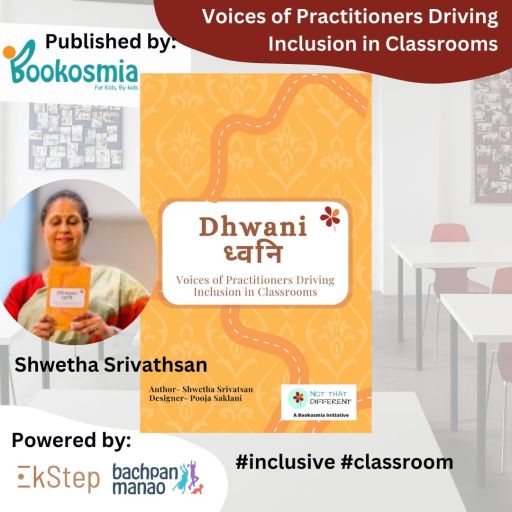
Dhwani I Voices of Practitioners Driving Inclusion in Classrooms
https://bookosmia.com/teachers-mental-health-inclusive-classrooms/


Gift Books On Inclusion — A package of 5 books on inclusion, empathy, and working together.
***
This article is published by Bookosmia, India’s #1 publisher for and by young people. Bookosmia publishes stories, books, podcasts, events, TED-Ed talks, workshops, bedtime stories and more related to kids and young adults.
Photo Credit – AI generated images from Chat GPT and Magic Media from Canva .
Want to publish your articles, reviews, stories, audio stories, bedtime stories and poems ?
Did you know that children can submit audio stories to be turned into Bedtime Stories and published on Bedtime Stories – A Podcast by Bookosmia?
Write to us at sara@bookosmia.com or submit your article at the link below
Read More
What Are Accommodations? Why Do They Matter? What Accommodations Do Different Boards Provide?