Imagine that you are standing in a laboratory late at night. Around you are enormous machines, powerful magnets, miles of cables and computers covered in numbers you don’t understand. Somewhere inside one of those machines, scientists have trapped something almost unbelievably tiny.
It isn’t a piece of metal. It isn’t a strange chemical. It isn’t a tiny alien.
It is antimatter.
For a moment, everything is perfectly calm. The antimatter particle is floating inside an invisible electromagnetic trap, carefully kept away from ordinary matter. If it touches the walls of its container, it won’t remain there for long. The particle and the ordinary matter will interact, releasing energy.
It sounds like the opening scene of a science-fiction movie. But antimatter is real. Scientists have produced it, trapped it and studied it. And the strangest thing about it isn’t even what it does. The strangest thing is that antimatter may hold a clue to one of the biggest questions humanity has ever asked: Why does the universe exist in the form we see today?
To understand antimatter, we first need to understand ordinary matter. Look around you. Your chair, your clothes, the air you breathe, the trees outside, the Earth beneath your feet and the stars above your head are all made of matter. Matter is built from atoms, and atoms themselves are made from smaller particles such as electrons, protons and neutrons.
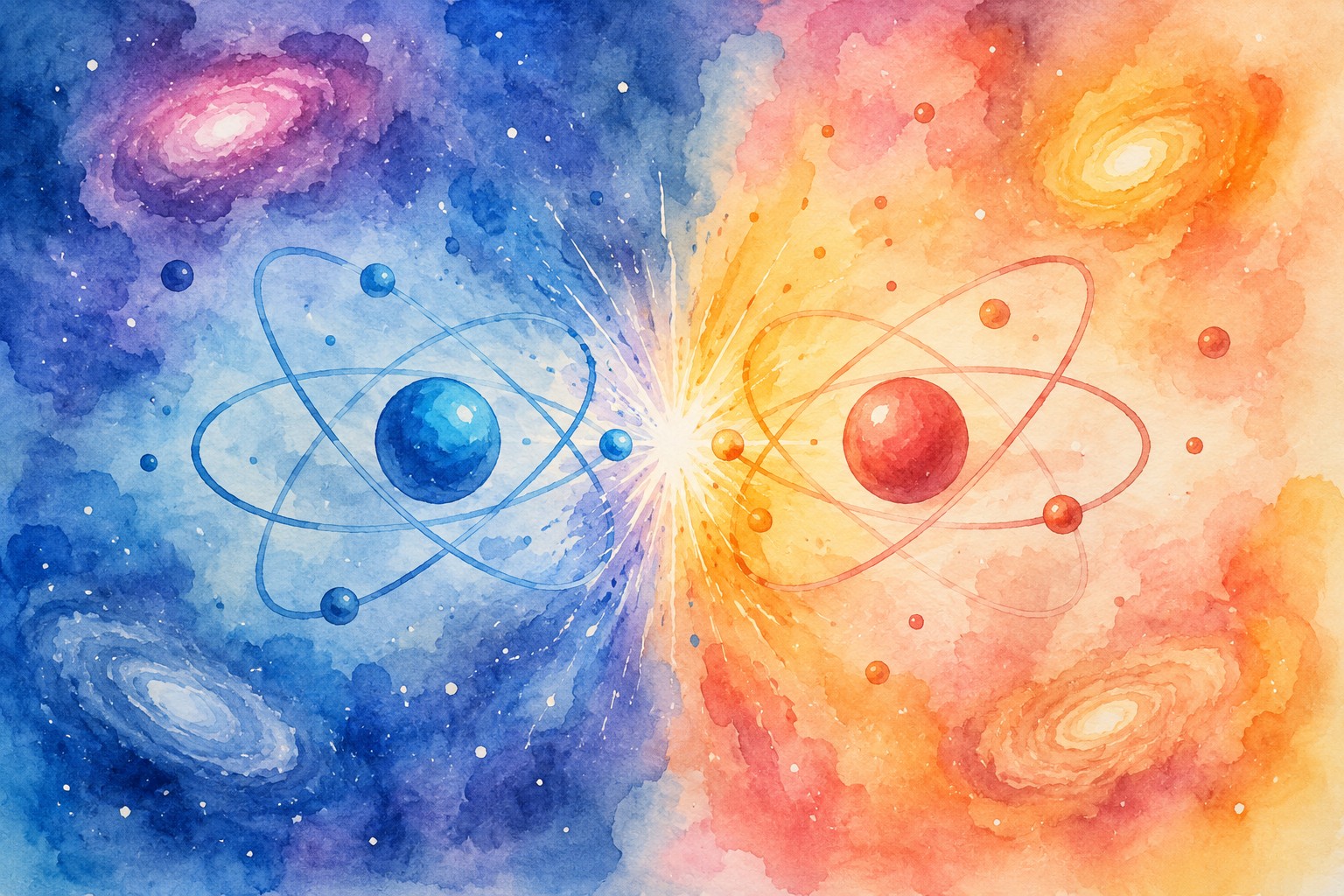
But nature has a fascinating trick. Many particles have another particle that is almost like their mirror image. These are called antiparticles.
Take the electron. An electron has a negative electric charge. Its antiparticle, called a positron, has the same mass as an electron but a positive electric charge. The proton has an antiparticle called an antiproton. Even the neutron, which has no overall electric charge, has an antiparticle called an antineutron.
You can think of particles and antiparticles as pairs of cosmic twins. They aren’t identical twins, though. They have opposite versions of certain properties, such as electric charge.
And this is where the story becomes wonderfully strange.
When a particle encounters its corresponding antiparticle, they can annihilate one another. Don’t let the word fool you into imagining that they simply disappear into nothing. Their mass can be converted into energy and other particles. In many cases, this produces photons—the particles that make up light.
This is connected to one of the most famous equations ever written: E = mc².
Einstein’s equation tells us that mass and energy are deeply connected. Even a tiny amount of mass corresponds to a surprisingly large amount of energy because c, the speed of light, is an enormous number.
So, when matter and antimatter meet, some of their mass can be transformed into energy. That sounds incredibly powerful—and it is. But antimatter isn’t some magical substance that automatically explodes the moment someone makes it. The matter and antimatter need to interact.
And that creates a rather awkward problem for scientists.
Imagine trying to keep a soap bubble from touching anything while also preventing it from floating away. Now shrink that bubble down to something far smaller than a grain of sand and make it impossible to see with your eyes. That’s still not quite the same problem scientists face, but it gives you an idea of how unusual the challenge is.
Scientists can’t simply put antimatter in a normal bottle. The bottle itself is made of ordinary matter. Instead, charged antiparticles can be controlled using electric and magnetic fields. These fields can act like an invisible cage, keeping the particles suspended away from the walls of the equipment.
Researchers have even managed to create antihydrogen.
Hydrogen is the simplest ordinary atom. It contains a proton and an electron. Antihydrogen contains an antiproton and a positron—the antimatter versions of those particles.
Creating antihydrogen is an incredible scientific achievement, but creating it is only the beginning. Scientists then must trap it and study it before it encounters ordinary matter.
Why spend so much effort studying something that is so tiny and difficult to handle?
Because antimatter might explain something much, much bigger.
Something happened during the earliest moments of our universe that we don’t fully understand.
According to our current understanding of physics, the young universe should have produced matter and antimatter in nearly equal amounts. If that had happened in a perfectly balanced way, there would be a serious problem.
Matter and antimatter can annihilate when they meet. So, if the universe had created exactly equal amounts of both, much of the matter and antimatter could have destroyed one another, leaving behind a universe filled mostly with radiation.
But that’s not the universe we live in.
Look around. There are galaxies everywhere. Stars shine across enormous distances. Planets orbit stars. On at least one of those planets, life appeared. Eventually, one species developed telescopes, particle accelerators and a habit of asking extremely complicated questions.
So somehow, the universe ended up with more matter than antimatter.
Scientists call this mystery the matter-antimatter asymmetry.
Here’s where the numbers become almost ridiculous to imagine. The difference may have been incredibly tiny—something like a very small excess of matter left over after most matter and antimatter annihilated each other. That leftover matter eventually became the raw material for everything we know.
Stars. Planets. Oceans. Mountains. Trees.
And people.
That means there is a fascinating possibility: the existence of everything around us may depend on an incredibly small imbalance in the early universe.
If that imbalance hadn’t existed, the universe could have looked completely different.
Scientists don’t yet know exactly what caused it. They have several ideas, and experiments are testing them. Researchers are looking for subtle differences between matter and antimatter that could explain why matter gained that tiny advantage.
And here’s something even more surprising: antimatter isn’t only useful for studying the beginning of the universe. It already has practical applications.
One example is PET scanning, a medical imaging technique. PET stands for positron emission tomography. It uses substances that produce positrons. When those positrons encounter electrons inside the body, they annihilate and produce detectable signals. Sophisticated machines can use those signals to create images that help doctors study what is happening inside the body.
So antimatter isn’t just hiding inside enormous physics laboratories. One of its properties has found a place in modern medicine.
But what about space travel?
You’ve probably encountered the idea in science fiction: a spaceship powered by antimatter, zooming across the galaxy at incredible speeds. It sounds fantastic because antimatter reactions can release a huge amount of energy compared with ordinary chemical reactions.
Unfortunately, there’s a gigantic problem.
Scientists can produce tiny quantities, but creating large amounts would require enormous amounts of energy and sophisticated equipment. Storing it safely is another challenge entirely. We are nowhere near having giant tanks of antimatter powering spacecraft.
Still, scientists continue to study it because the goal isn’t necessarily to build a science-fiction spaceship tomorrow.
The real goal is understanding nature.
And that’s what makes antimatter so fascinating. It isn’t merely a strange material with an impressive reaction. It is a question mark built into the universe.
Why does antimatter exist at all? Why does matter seem to dominate the universe around us? Are the laws governing matter and antimatter truly identical? Could there be some tiny difference that we haven’t discovered yet?
Perhaps the answer is hiding inside an experiment happening right now in a laboratory somewhere on Earth.
Maybe one day, a scientist will notice something unexpected—a tiny result that doesn’t fit the predictions. Perhaps that tiny difference will lead to a completely new understanding of the universe.
For now, antimatter remains one of nature’s greatest mysteries.
It is the mirror beside our universe, showing us, what things might look like if some of their most fundamental properties were reversed. It can annihilate with ordinary matter and turn mass into energy. It can be trapped by invisible fields. It can help doctors create images of the human body. And, most importantly, it may help explain why the universe didn’t simply become a sea of energy billions of years ago.
There is something almost poetic about that.
Everything you see—the stars above you, the ground beneath you, the screen you’re reading this on, even the atoms that make you—may exist because, at the beginning of time, matter managed to win a tiny cosmic game of numbers.
We don’t yet know why it won.
And perhaps that’s the most exciting part.
Because every time scientists create another particle of antimatter, they aren’t just making something strange in a laboratory.
They’re getting a little closer to understanding why we’re here at all.

What is antimatter?
Antimatter is a form of matter made from antiparticles. These particles have the same mass as their ordinary counterparts but opposite properties, such as electric charge.
What is an antiparticle?
An antiparticle is the counterpart of an ordinary particle. For example, the electron’s antiparticle is the positron, which has a positive charge.
What happens when matter meets antimatter?
They can annihilate each other, converting their mass into energy and other particles, often including photons.
Why can’t antimatter be stored in an ordinary container?
An ordinary container is made of matter. If antimatter touches its walls, it can annihilate. Scientists therefore use electromagnetic fields to keep charged antiparticles away from ordinary matter.
What is antihydrogen?
Antihydrogen is the antimatter counterpart of hydrogen. It is made from an antiproton and a positron.
Why is antimatter important for understanding the universe?
Scientists believe the early universe should have produced matter and antimatter in nearly equal amounts. Since our universe contains much more matter, studying antimatter may help explain this mysterious imbalance.
What is matter-antimatter asymmetry?
It is the unexplained difference between the amount of matter and antimatter in the universe. Even a tiny excess of matter could have eventually led to the stars, planets and everything we see today.
Is antimatter used in medicine?
Yes. PET scans use positrons. When positrons meet electrons inside the body, they annihilate and produce signals that can be detected to create medical images.
Could antimatter be used to power spaceships?
In theory, antimatter could release enormous amounts of energy. However, producing and storing sufficient antimatter is extremely difficult and expensive, so antimatter-powered spacecraft remain science fiction for now.
Does antimatter simply disappear when it meets matter?
No. Matter and antimatter can annihilate, but their mass is converted into energy and other particles. They do not simply vanish into nothing.
Why do scientists continue studying antimatter?
Antimatter could reveal whether there are subtle differences between matter and antimatter and help scientists understand why our universe is dominated by matter.
What is the biggest mystery surrounding antimatter?
The biggest mystery is why the universe contains far more matter than antimatter. Scientists are still searching for the reason behind this tiny but incredibly important cosmic imbalance.
Where can you buy the books?
You can buy the books at Bookosmia.com and Amazon.in
Mohini Made Friends I Children’s Book About Friendship and Dance
Follow Mohini, a little girl who communicates through dance and hand gestures. She is shunned as no one seems to understand her, but she finally finds the beautiful magic of friendship. The book is an attempt to bring children, and elders alike, to the captivating story of mohiniyattam through creative non-fiction. This book, Published by Bookosmai, celebrates the rich cultural heritage of Mohiniyattam and its journey from obscurity to recognition, with beige, black, and yellow illustrations representing the dance’s costume. All through a little girl and her simple world. Get your copy now and join Mohini on her enchanting journey! Authored by: Shruthi KP Illustrated by: Rohit Bhasi A4 size.

This article is published by Bookosmia, India’s #1 publisher for and by young people. Bookosmia publishes stories, books, podcasts, events, TED-Ed talks, workshops, bedtime stories and more related to kids and young adults.
Photo Credit – AI generated images from Chat GPT and Magic Media from Canva .
Want to publish your articles, reviews, stories, audio stories, bedtime stories and poems ?
Did you know that children can submit audio stories to be turned into Bedtime Stories and published on Bedtime Stories – A Podcast by Bookosmia?
Write to us at sara@bookosmia.com or submit your article at the link below
Get Published