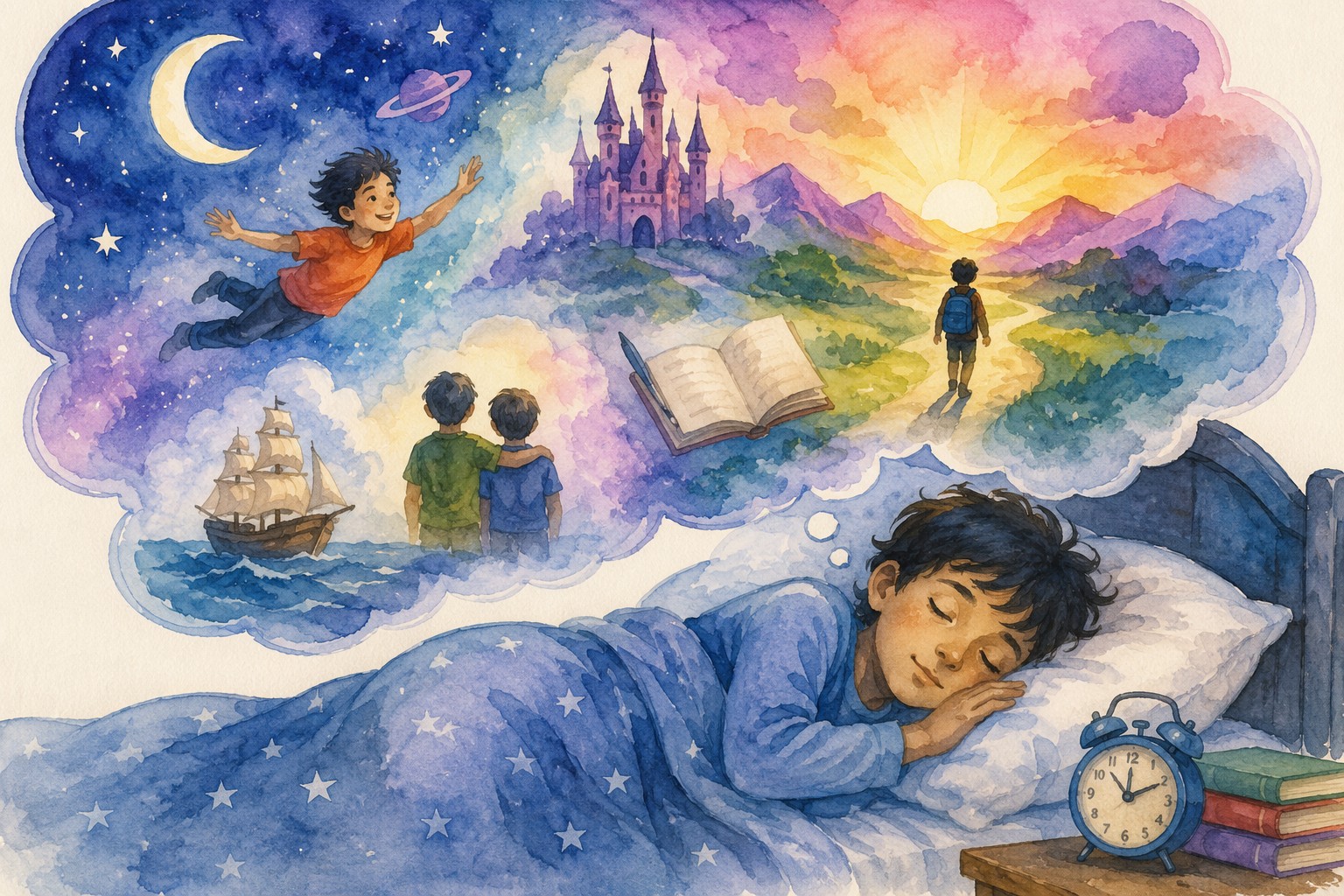
Dreams are among the most fascinating experiences of human life. Every night, our minds create stories that can be beautiful, terrifying, emotional, or completely bizarre. We may find ourselves flying through the sky, meeting people we have not seen in years, solving impossible problems, or living through situations that make absolutely no sense. Yet while dreams feel incredibly real, scientists still cannot answer one simple question with complete certainty: Why do we dream?
Although modern neuroscience has transformed our understanding of the human brain, dreams remain one of its greatest unsolved mysteries. Researchers know when dreams occur, which parts of the brain become active, and even how dreams affect memory and emotions, but the exact purpose of dreaming is still debated. Rather than supporting a single explanation, today’s evidence suggests that dreams may perform several important functions at the same time. They may help us organize memories, regulate emotions, inspire creativity, rehearse survival situations, and even reveal how consciousness itself works.
Many people believe they rarely dream or perhaps never dream at all. Surprisingly, science tells us the opposite. Nearly every healthy person dreams every single night. A typical individual experiences four to six dream periods during sleep, adding up to almost two hours of dreaming before morning arrives. The reason many people believe they do not dream is simply because they forget them.
Most dreams occur during rapid eye movement (REM) sleep, a stage in which brain activity becomes almost as intense as it is during wakefulness. During REM sleep, your eyes move rapidly beneath your eyelids, your breathing becomes less regular, and your brain becomes highly active while your muscles remain temporarily relaxed. This temporary paralysis prevents you from physically acting out your dreams, making sleep much safer.
Interestingly, dreams are incredibly fragile memories. Within minutes of waking, the majority of dreams begin fading away because the brain does not store them as effectively as ordinary waking experiences. Unless you wake directly from a dream or write it down immediately, it is likely to disappear almost completely.
Although sleep may appear peaceful from the outside, your brain is actually remarkably busy. Throughout the night, billions of neurons communicate with one another, strengthening important connections while weakening others. The brain repairs itself, clears away waste products, organizes memories, and prepares itself for another day of learning.
Brain imaging studies have shown that different regions behave very differently during dreaming. Emotional centers such as the amygdala become highly active, helping explain why dreams often feel emotionally intense. At the same time, areas responsible for logical reasoning and critical thinking become less active. This combination creates a unique mental environment where impossible events seem perfectly normal and emotions often overpower logic.
Because the brain is processing so much information simultaneously, scientists believe dreams are not random accidents but rather reflections of the complex work taking place while we sleep.
One of the strongest scientific explanations suggests that dreams help organize memories. Every day, our brains receive an overwhelming amount of information—from conversations and school lessons to faces, emotions, sounds, and random observations. Not all of this information deserves permanent storage, so the brain must decide what is worth remembering and what can safely be forgotten.
During sleep, researchers believe the brain reviews recent experiences, strengthens important memories, and removes unnecessary details. Dreams may simply be the conscious experience of this sorting process. This idea explains why dreams often combine unrelated people, places, and events into strange stories. A classmate may suddenly appear in your childhood home, or a family vacation may somehow take place inside your school. These combinations may reflect the brain linking memories according to similarities or emotional significance rather than chronological order.
Scientists have also discovered that good sleep improves learning and memory. Students who sleep well after studying generally remember information better than those who stay awake all night, suggesting that the sleeping brain actively strengthens newly learned material.
Have you ever noticed that after a stressful day, your dreams become unusually emotional? This observation has led many neuroscientists to believe that dreams help process feelings that remain unresolved during the day.
During REM sleep, emotional areas of the brain become particularly active while stress-related chemicals decrease. This creates a relatively safe environment in which the brain can revisit difficult experiences without exposing the body to actual danger. Instead of solving external problems, dreams may help organize our internal emotional world.
This theory explains why dreams frequently involve situations related to anxiety, embarrassment, excitement, grief, or happiness. A dream about missing an important exam, for example, may not predict failure but instead reflect feelings of pressure or uncertainty. Likewise, dreaming about loved ones often represents emotional connections rather than hidden messages. In this sense, dreams may function as a form of overnight emotional therapy, allowing us to wake up mentally refreshed.
Another fascinating explanation is known as the Threat Simulation Theory. According to this idea, dreams evolved because they allowed early humans to mentally practice dangerous situations before encountering them in real life.
For our ancestors, survival depended on reacting quickly to predators, harsh environments, conflicts, and other life-threatening situations. A brain capable of rehearsing these dangers during sleep would have provided a significant evolutionary advantage. Even though modern humans rarely face the same threats, our dreams continue to simulate challenging situations.
This theory helps explain why some of the world’s most common dreams involve falling, being chased, becoming lost, arriving late, or facing unexpected danger. These experiences may represent ancient survival mechanisms that continue to operate even though our daily lives have changed dramatically.
Dreams are often wonderfully illogical, and that may actually be one of their greatest strengths. While we are awake, our brains constantly filter ideas using logic and experience. During dreams, many of these restrictions disappear, allowing unrelated ideas to combine in surprising ways.
History contains several examples of discoveries inspired by dreams. The German chemist August Kekulé reportedly imagined the ring-shaped structure of benzene after dreaming of a snake biting its own tail. Many artists, musicians, writers, and inventors have also described waking with ideas that first appeared in dreams.
Although dreams do not magically produce knowledge, they encourage creative thinking by allowing the brain to experiment freely. Sometimes, stepping away from conscious problem-solving allows unexpected solutions to emerge naturally during sleep.
Not every scientist believes dreams have an important purpose. One influential explanation, called the activation-synthesis theory, argues that dreams result from the brain trying to make sense of random electrical signals generated during REM sleep.
According to this theory, neurons fire spontaneously while we sleep. Rather than ignoring this activity, the brain automatically constructs stories to explain the random signals, much like creating a movie from unrelated scenes. This would explain why dreams often change location instantly, introduce impossible events without explanation, or shift between completely unrelated storylines.
Although this theory successfully explains the bizarre nature of many dreams, critics argue that it cannot fully explain why dreams are often emotionally meaningful or why they frequently incorporate recent experiences. Today, many scientists believe random brain activity may contribute to dreams, but it is unlikely to be the entire explanation.
One of the most fascinating characteristics of dreams is how easily they ignore reality. In dreams, people may fly, breathe underwater, speak with historical figures, or instantly travel across the world without questioning any of it. Only after waking do these experiences seem impossible.
Researchers believe this happens because the brain regions responsible for critical thinking become less active during REM sleep, while visual imagination and emotional processing remain highly active. As a result, the dreaming brain accepts impossible situations without asking whether they make logical sense.
In many ways, dreaming resembles storytelling. The brain values emotion, symbolism, and imagination more than accuracy, allowing it to construct vivid experiences that feel completely believable while they are happening.
Throughout history, countless cultures have believed dreams can reveal future events or hidden truths. Stories of prophetic dreams appear in ancient civilizations, religious traditions, and modern folklore alike.
However, scientific research has found no reliable evidence that dreams consistently predict the future. When people remember dreams that appear to come true, psychologists often explain this through coincidence, selective memory, and pattern recognition. Humans naturally remember the rare dream that resembles a future event while forgetting the thousands that never do.
That does not make dreams meaningless. Instead, many psychologists believe dreams reveal far more about our current emotions, fears, hopes, and priorities than about future events.
Among all dream experiences, lucid dreaming remains one of the most extraordinary. During a lucid dream, the dreamer becomes aware that they are dreaming while the dream continues. Some people can even influence what happens next, choosing where to go, what to do, or how the dream unfolds.
Scientists have become increasingly interested in lucid dreaming because it provides a unique opportunity to study consciousness. Brain scans show that certain areas associated with self-awareness become more active during lucid dreams than during ordinary dreaming. This suggests that consciousness exists on a spectrum rather than as a simple “awake or asleep” state.
Although not everyone experiences lucid dreams regularly, they demonstrate just how flexible and remarkable the human mind truly is.
Despite decades of research using advanced brain imaging, sleep laboratories, and neuroscience experiments, no single theory explains every aspect of dreaming. Instead, dreams likely serve multiple purposes at once. They may organize memories, regulate emotions, inspire creativity, rehearse challenging situations, strengthen learning, and sometimes simply reflect the brain’s ongoing activity during sleep.
This complexity is precisely what makes dreaming one of neuroscience’s greatest unsolved mysteries. Every new discovery answers one question while raising several more. Scientists continue to investigate why different people dream differently, why some dreams become unforgettable while others disappear instantly, and whether dreams play an even larger role in mental health than we currently understand.
Every night, while we sleep peacefully, our brains perform one of nature’s most remarkable acts of creativity. Without any conscious effort, they build entire worlds filled with people, places, emotions, and stories that can feel astonishingly real. Whether dreams are organizing memories, processing emotions, inspiring creativity, rehearsing survival, or doing all of these things at once, they reveal just how extraordinary the human brain truly is.
Perhaps one day neuroscience will finally uncover the complete answer to why we dream. Until then, every dream remains a reminder that even within our own minds, there are still mysteries waiting to be explored. As technology advances and our understanding of the brain deepens, the answer may eventually emerge—but until that day arrives, dreams will continue to be one of the most beautiful and intriguing puzzles of human existence.

Why do humans dream every night?
Most scientists believe dreaming helps the brain process memories, regulate emotions, and strengthen learning, although its exact purpose is still being studied.
What is REM sleep?
REM (Rapid Eye Movement) sleep is a stage of sleep where brain activity is highly active, most vivid dreams occur, and the body temporarily relaxes its muscles.
Why do we forget our dreams so quickly?
Dreams fade rapidly because the brain doesn’t store dream memories as effectively as waking experiences.
How do dreams help with memory?
Research suggests that during sleep, the brain organizes new information, strengthens important memories, and removes unnecessary details.
Can dreams help us process emotions?
Yes. Many scientists believe dreams allow the brain to safely process emotions such as stress, anxiety, happiness, and fear.
Does getting enough sleep improve learning?
Yes. Studies show that quality sleep helps strengthen memory, improves concentration, and supports better learning.
Why do dreams often seem so strange or unrealistic?
During REM sleep, the brain’s imagination and emotional centers are highly active while logical thinking is reduced, making unusual events seem normal.
Can dreams predict the future?
There is no scientific evidence that dreams can reliably predict future events. They are more likely to reflect our thoughts, emotions, and experiences.
What is lucid dreaming?
Lucid dreaming is when a person becomes aware they are dreaming and may even be able to control parts of the dream.
What is the activation-synthesis theory?
It suggests that dreams are the brain’s attempt to make sense of random electrical signals produced during REM sleep.
Why are scientists still studying dreams?
Dreams remain one of neuroscience’s biggest mysteries because no single theory explains all aspects of dreaming.
What is the biggest mystery about dreams?
Scientists still do not know the exact purpose of dreaming. Current research suggests dreams may help with memory, emotions, creativity, learning, and brain function all at once.
Where can you buy the books?
You can by the books at Bookosmia.com and Amazon.in
Mohini Made Friends I Children’s Book About Friendship and Dance
Follow Mohini, a little girl who communicates through dance and hand gestures. She is shunned as no one seems to understand her, but she finally finds the beautiful magic of friendship. The book is an attempt to bring children, and elders alike, to the captivating story of mohiniyattam through creative non-fiction. This book, Published by Bookosmai, celebrates the rich cultural heritage of Mohiniyattam and its journey from obscurity to recognition, with beige, black, and yellow illustrations representing the dance’s costume. All through a little girl and her simple world. Get your copy now and join Mohini on her enchanting journey! Authored by: Shruthi KP Illustrated by: Rohit Bhasi A4 size.

This article is published by Bookosmia, India’s #1 publisher for and by young people. Bookosmia publishes stories, books, podcasts, events, TED-Ed talks, workshops, bedtime stories and more related to kids and young adults.
Photo Credit – AI generated images from Chat GPT and Magic Media from Canva .
Want to publish your articles, reviews, stories, audio stories, bedtime stories and poems ?
Did you know that children can submit audio stories to be turned into Bedtime Stories and published on Bedtime Stories – A Podcast by Bookosmia?
Write to us at sara@bookosmia.com or submit your article at the link below
Get Published