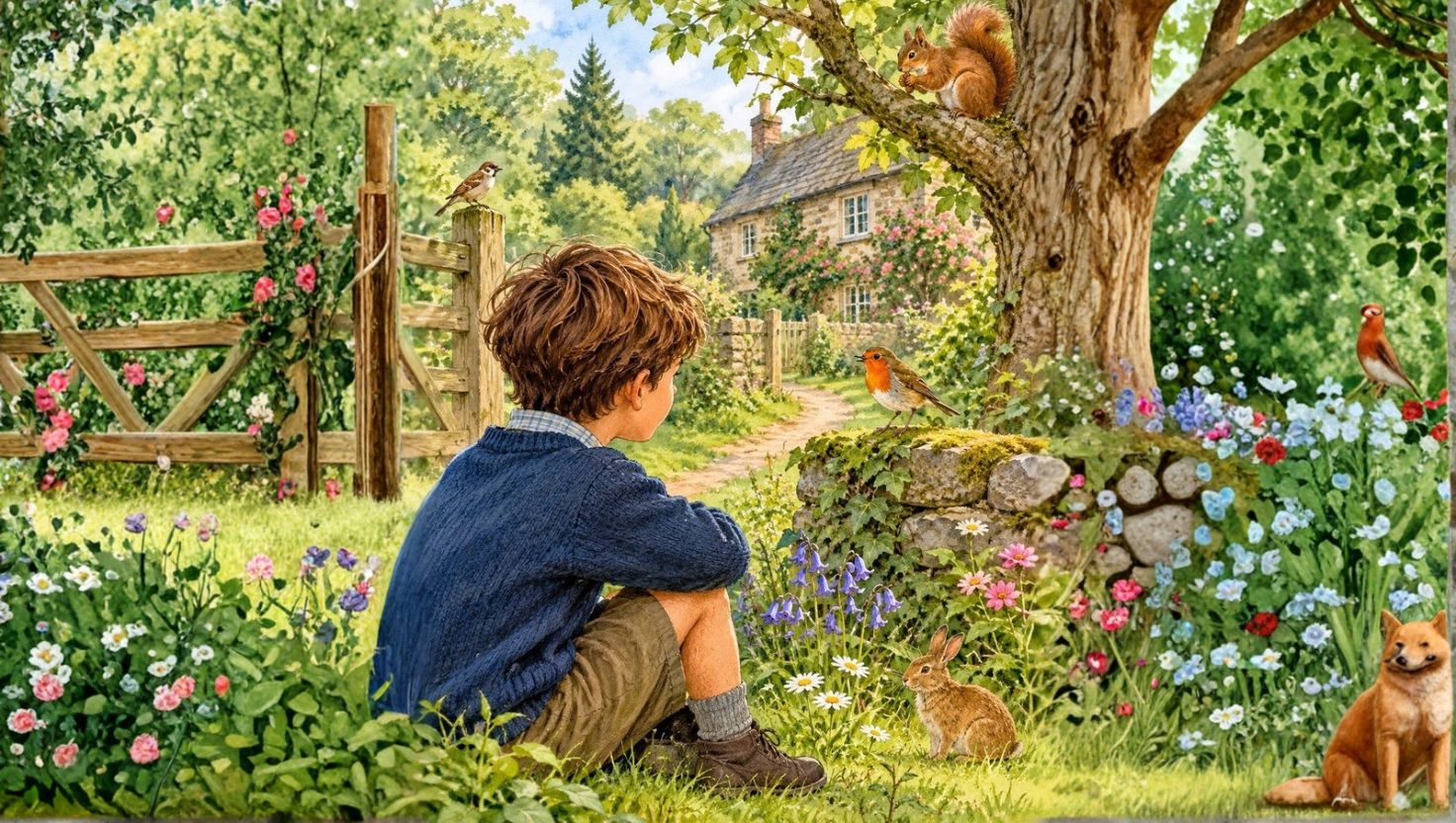
Robert was seven years old when his world changed. He had always been close to his grandmother. She was his first true friend, the person who listened patiently to his questions and made even an ordinary afternoon feel special. She told him gentle stories about honesty, courage and kindness. Most of all, she taught him to care for every living thing, however small.
When his grandmother was gone, Robert missed her stories and her comforting presence. His grandfather stayed beside him, and the lessons she had left behind became a quiet guide in his life. Robert began to understand that love does not disappear when someone is no longer there. It can remain in the things they teach us and in the kindness we pass on.
Robert lived with his grandfather in a peaceful village in England. Their home stood among gardens, old trees and green fields. Beyond the village lay a woodland path, and beyond that a wide stretch of countryside where birds called from hedges and the wind moved softly through the grass.
Robert did not have many close friends his own age. But he was never truly alone. There were sparrows on the roof, a robin in the garden, squirrels in the trees, chickens near the farm and dogs that wandered along the lanes. To Robert, each creature had its own character and its own place in the world.
His grandfather loved gardening. Each morning he worked among the flower beds, loosening the soil, watering young plants and checking the vegetables. Robert often followed him, carrying a small watering can or collecting fallen leaves.
“A garden is not only for people,” his grandfather told him one day. “It is a home for many little lives. If we look carefully, we will see them.” After that, Robert began to notice things he had overlooked. Asparrow searched for crumbs beneath the bench. A robin hopped between the flower pots. A squirrel paused on a branch, holding a nut in its tiny paws. Near the fence, a line of ants travelled busily through the grass. Robert learned to leave a quiet corner of the garden undisturbed. He never chased the birds or tried to catch the squirrels. Instead, he watched from a little distance. His grandfather explained that wild creatures needed space, clean water and safe places to find food. The garden became Robert’s favourite place. It was a small world, full of movement and sound, and every day it seemed to have something new to show him.
On school mornings, Robert walked along a woodland path with his grandfather. The path wound between trees before reaching the village school. In spring, fresh leaves opened above them. In autumn, the ground became a patchwork of gold and brown. Robert loved the journey almost as much as the destination. He listened to birdsong, watched the changing clouds and looked for signs of animals. Sometimes they saw a rabbit disappearing into the undergrowth or a squirrel racing up a tree. They occasionally heard stories of beavers living near the waterways, shaping their surroundings in remarkable ways. His grandfather taught him to observe without disturbing. They did not pull at plants, damage nests or leave litter behind. If they found a creature that seemed hurt, they told a responsible adult rather than trying to handle it themselves. At school, Robert was quiet, but he enjoyed lessons about the natural world. He began keeping a little notebook. In it he drew leaves, described birds and recorded the things he noticed on the path. The notebook became a record of his growing curiosity.
Robert’s interest in wildlife grew whenever he visited the village library. He searched the shelves for books about forests, animals and distant places. He became especially interested in the adventures of naturalists and wildlife writers, including Gerald Durrell, whose books showed him how fascinating animals could be. He dreamed of becoming a wildlife adventurer one day. He imagined travelling through forests, watching animals in their natural homes and learning how people could protect them. But his grandfather reminded him that an explorer did not have to travel far to begin learning.
“Start by understanding the place where you live,” he said.
“Learn the names of the birds in our garden. Notice which flowers attract insects. Find out what the trees need. Respect begins with attention.” Robert took the advice seriously. He read, asked questions and added new discoveries to his notebook. The more he learned, the more he understood that wildlife was not something separate from human life. Every creature was part of a larger world, and that world depended on care.
One chilly afternoon, Robert noticed that the garden birds were struggling to find food. He told his grandfather, who helped him make a simple bird-feeding place in a safe spot where the birds could visit without being disturbed. They cleaned the bird bath and made sure it held fresh water. Robert learned that caring for wildlife was not about making pets of wild animals. It was about helping them in thoughtful ways while allowing them to remain free. A few days later, a robin returned to the garden. It perched on the fence, its bright breast standing out against the winter light. Robert watched quietly. He felt pleased, not because the bird belonged to him, but because the garden had become a little more welcoming. He also began helping his grandfather grow flowers and vegetables. They shared some of the harvest with neighbours, and Robert learned that generosity could be as simple as giving someone a handful of fresh apples or helping an older neighbour carry a basket. His grandmother’s old stories came back to him then. Their lessons were no longer just words. Robert was beginning to live them.
As Robert grew older, he noticed that the woodland path was becoming untidy. People sometimes dropped wrappers, and a few young plants had been trampled near the edge. He worried that the birds and other small creatures would lose some of their safe places. He spoke to his grandfather, who suggested that Robert share his concerns with the school. With the help of a teacher, Robert and several classmates organised a village clean-up day. They invited families and neighbours to join them. The children collected litter with adults nearby, sorted what could be recycled and placed simple reminders along the path asking visitors to respect the woodland. They did not disturb nests or enter sensitive areas. Instead, they learned how to care for the place by leaving it as natural as possible. The day brought the village together. People who had hardly spoken before worked side by side. Some planted native flowers in suitable places, while others helped repair a noticeboard. Robert was surprised by how much could be achieved when everyone offered a little time. That evening, as he walked home, the woodland seemed more beautiful than ever. He knew the work would have to continue, but he also knew that a small beginning could grow into something meaningful.
Years passed. Robert kept his notebook and his love of the natural world. He still enjoyed gardening with his grandfather, watching birds and walking along the woodland path. He read more books, learned from people who studied wildlife and began sharing what he knew with younger children. He never forgot his grandmother. Whenever he saw a robin in the garden or heard a familiar bird call, he remembered her stories about kindness. Whenever his grandfather showed him how to care for a plant, he remembered the patience and love that had shaped his childhood.
Robert came to understand that a joyful life did not need to be filled with expensive things or grand adventures. It could be found in a quiet morning, a garden after rain, a shared meal, a helpful neighbour or the sight of a small bird returning to a tree.
He hoped to explore the wider world one day, but he no longer believed that adventure began only in faraway places. It began whenever someone looked closely, asked a question and treated the living world with respect.
And so, in that little English village, Robert continued to learn. The sparrows still visited the roof, the squirrels still hurried through the branches, and the robin still appeared from time to time. The world around him was full of stories. He had only to be patient enough to listen.
The End
A little kindness can make the world a better home for every living thing.
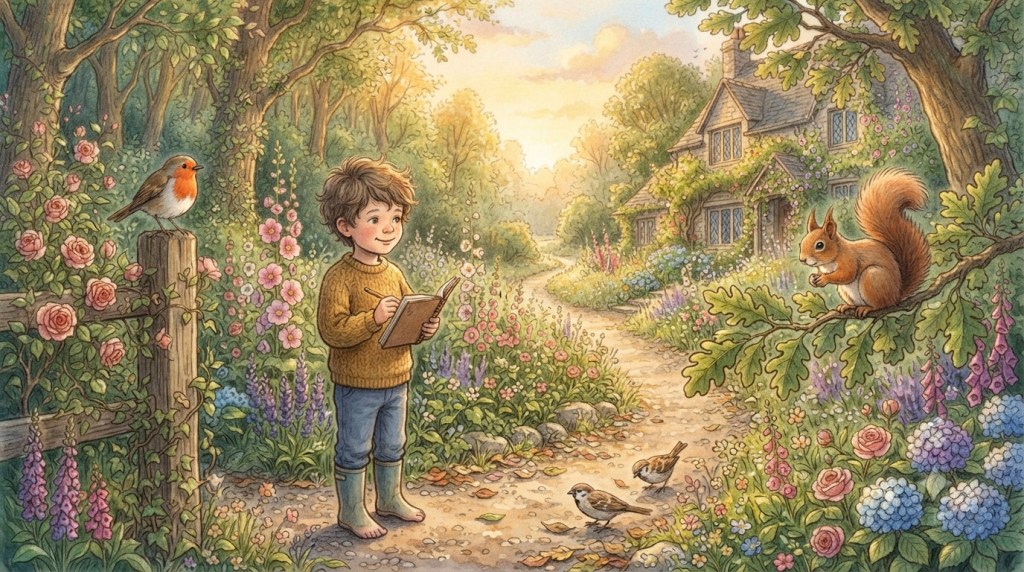
Where did Robert learn to love wildlife? From his grandmother’s gentle stories and his grandfather’s patient guidance, which taught him respect and care for every living creature in their peaceful English village.
How did Robert observe and care for wild creatures without disturbing them? He watched from a little distance, left quiet corners of the garden undisturbed, never chased birds or tried to catch squirrels, kept plants and nests untouched, and helped provide food and fresh water while letting wild animals remain free. If he found an injured creature, he told a responsible adult instead of handling it himself.
What was “The Day the Village Came Together”? It was a community clean-up day organized by Robert and his classmates, with the help of a teacher and family members, to clear litter and protect the woodland path showing how small actions can create meaningful change and bring neighbors together.
How can I pass on kindness? Like Robert, you can share what you have,such as fresh apples from the garden , help neighbors and live out the lessons of care and generosity taught to you.
Is a joyful life only found in faraway places? No. As Robert learned, adventure and joy begin when you look closely, ask questions, treat the living world with respect, and appreciate quiet moments right where you are.
***
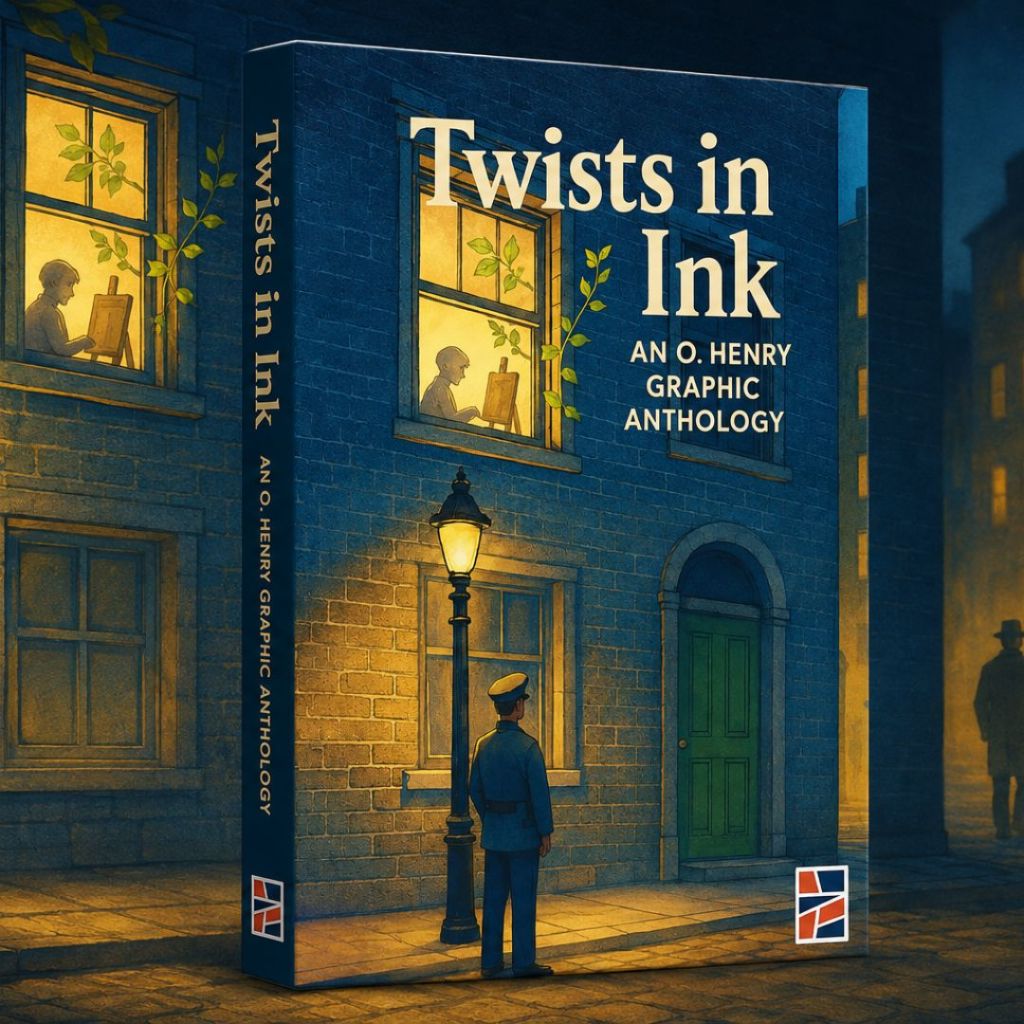
Twists In Ink – An O. Henry Graphic Anthology
https://www.amazon.in/dp/B0HLZLD8HJ
Classic stories. Fresh illustrations. Unexpected twists. Twists in Ink – published by Bookosmia, brings the timeless stories of O. Henry to life for a new generation of readers aged 10 and above. Through an engaging graphic-novel format, young readers can discover stories of kindness, sacrifice, love, second chances, and human connection, while experiencing O. Henry’s unforgettable surprise endings. Each story is illustrated in its own distinctive style, ranging from warm and tender to playful and adventurous, making classic literature accessible and enjoyable for young readers. The unexpected twists keep readers turning the pages until the very end, while parents and grandparents who grew up reading O. Henry can enjoy sharing these much-loved stories with a new generation. Twists in Ink is also thoughtfully designed for classroom learning, school libraries, reading programmes, and group discussions. Every story concludes with a “Think About It” page featuring three questions that encourage reading comprehension, literary analysis and critical thinking, and value education, helping children connect the stories to their own lives and experiences. Whether you are a young reader discovering O. Henry for the first time, a parent or grandparent introducing a timeless classic, or a teacher looking for engaging literature with educational value, Twists in Ink offers a fresh way to experience stories that continue to surprise, delight, and inspire. A timeless classic, reimagined to be enjoyed by young and old alike.
This article is published by Bookosmia, India’s #1 publisher for and by young people. Bookosmia publishes stories, books, podcasts, events, TED-Ed talks, workshops, bedtime stories and more related to kids and young adults.
Photo Credit – Royalty Free Images by Chat Gpt, Canva Ai, Magic Media, Jetpack Image editor, Gemini AI
Want to publish your articles, reviews, stories, audio stories, bedtime stories and poems ?
Did you know that children can submit audio stories to be turned into Bedtime Stories and published on Bedtime Stories – A Podcast by Bookosmia?
Write to us at sara@bookosmia.com or submit your article at the link below