A Heartfelt Reflection on Devotion, Humanity, and the Hypocrisy We Refuse to See
Everywhere, the air trembles with the divine fervour of Dussehra. Maa Durga has arrived, and the world seems to have draped itself in devotion. Magnificent pandals rise like palaces, lakhs and crores are spent on elaborate decorations, dazzling lights turn the night into a spectacle, and devotional songs echo through the streets. Everywhere, there is celebration, grandeur, and an overwhelming display of faith.
It is beautiful to witness. It truly is.
But sometimes, I wonder whether, in our eagerness to welcome the Goddess, we have forgotten to see the world through Her eyes.
For just beyond the glittering lights and magnificent pandals lies another world—a world our celebrations cannot illuminate, our devotional songs cannot console, and our festivity-struck eyes scarcely notice.
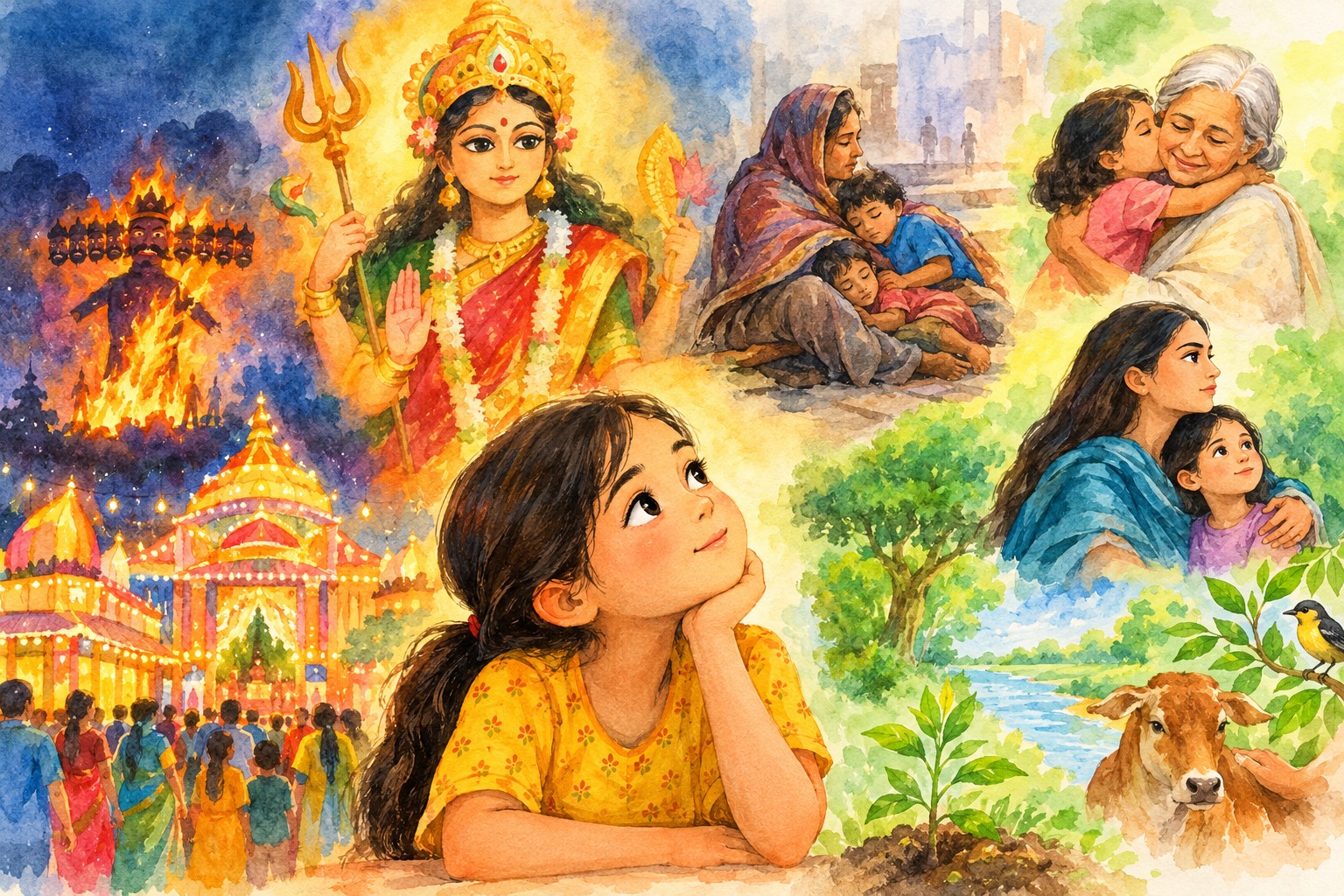
There, on cold, unforgiving footpaths, human beings lie beneath the open sky, with no roof to shelter them, no warm bed to comfort them, and sometimes not even a morsel of food to silence the ache of hunger. Perhaps a mother lies awake, her heart heavy with one desperate question: How will I feed my children tomorrow? Perhaps a little child falls asleep on the bare pavement, with an empty stomach and tears too exhausted to fall.
And just a few streets away, fortunes are spent on pandals that will stand for a handful of days before being dismantled, leaving behind little more than memories and discarded decorations.
Would the Goddess be any less honoured if our celebrations were a little simpler, but our hearts a little larger? Would Her glory diminish if the lights were fewer, but the lives we illuminated were many?
If a fraction of that wealth could put food into a hungry child’s hands, give a homeless family a safe place to sleep, or restore a little dignity to someone whom society has forgotten, would that not be an offering worthy of the Mother?
But then, we are great devotees, aren’t we?
We know how to fold our hands, bow our heads, chant sacred mantras, and cry, “Maa! Maa!” in ecstatic devotion. Yet, beyond the temple walls, how many ageing mothers sit in old-age homes, waiting for footsteps that may never return, longing for the embrace of children for whom they once sacrificed everything?
We call upon the Divine Mother with tears in our eyes, while our own mothers may be shedding tears in silence.
What greater contradiction can there be than to worship motherhood in an idol while neglecting the mother who gave us life?
We offer laddoos, pedas, and countless delicacies to the Goddess, yet hesitate to share a piece of bread with a hungry person. And sometimes, instead of compassion, we offer humiliation:
“Why don’t you work? Aren’t you ashamed of begging?”
But have we ever looked within ourselves? Do we not, too, stand before God with outstretched hands, asking for blessings, prosperity, success, and happiness?
“Dear God, fill my treasury with wealth. Make my children successful. Bless my family. Give me happiness and prosperity.”
Our prayers are overflowing with desires and expectations. But what if, one day, God granted none of our wishes? Would our devotion remain unchanged, or would our faith begin to falter?
Perhaps we do not always love God for who He is; sometimes, we love Him for what we hope to receive from Him.
And this contradiction does not end at the temple door.
We adorn Maa Durga with the finest garments and the most precious ornaments, yet women among us are stripped of their dignity, their freedom, and their sense of safety. We celebrate the power of the Mother while countless women continue to live in fear. Little girls, some barely three years old, are subjected to horrors that should be unimaginable in any society that calls itself civilised.
A girl should be able to walk without fear. A woman should be able to live without looking over her shoulder. A child should be able to trust the world into which she has been born.
These are not privileges. They are the most fundamental expressions of human dignity.
We bow before the Goddess, but how often do we stand up for the dignity of a woman?
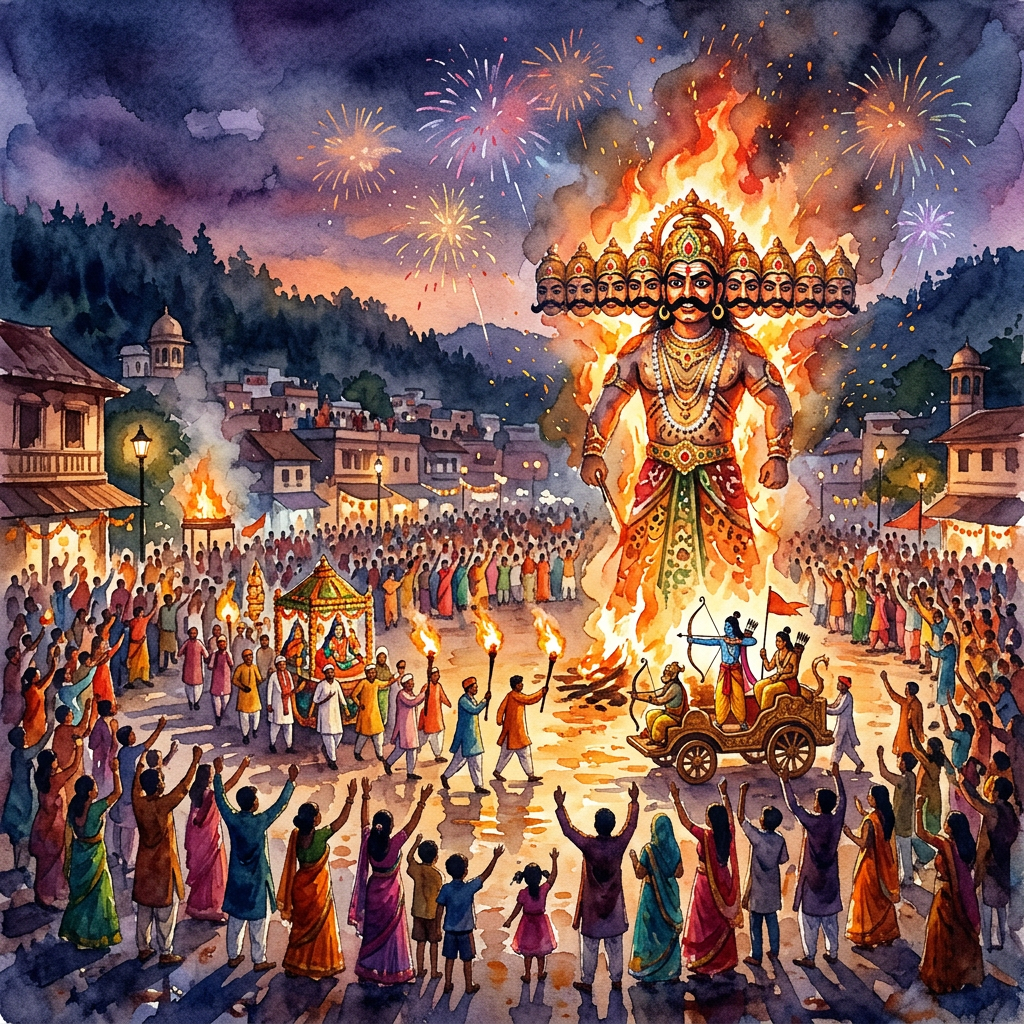
Maa Durga defeated Mahishasura. Lord Rama defeated Ravana. Every year, we burn effigies, illuminate the skies with fireworks, and cheer as evil is symbolically destroyed.
But when the flames die down and the smoke dissolves into the night, what truly changes within us?
The Ravana of our mythology is reduced to ashes every year, yet the Ravana within our hearts rises again with every Dussehra.
He lives in our lust, our greed, our cruelty, our arrogance, our prejudice, and our indifference to another’s suffering. The demons of hatred, violence, and injustice continue to wander through our streets, our homes, and sometimes the deepest corners of our own hearts.
How many effigies must we burn before we find the courage to confront the evil within ourselves?
Perhaps the greatest victory is not the one celebrated before a cheering crowd, but the one achieved in the quiet chambers of our conscience—when we choose kindness over cruelty, respect over domination, and humanity over selfish desire.
And while we celebrate the Mother, we often forget the creation that sustains us.
We fell trees that have stood for decades, giving little thought to the birds that will return to find their homes gone. We poison rivers that have nourished generations, pollute the air we breathe, and destroy the forests that shelter countless forms of life.
And in the name of rituals, innocent lives are taken, forgetting that every creature fears pain, clings to life, and longs to live—just as we do. An animal may not speak our language, but its silent suffering is no less real.
How can a life be sacrificed in the name of the Mother, whose very essence is compassion? We have become so accustomed to taking from nature that we have forgotten the grace of gratitude.
Prakriti itself is a manifestation of the Mother’s grace. She breathes through the forests, flows through the rivers, dances in the leaves, sings through the birds, and lives in every creature that shares this fragile earth with us.
She is in the rain that awakens thirsty soil, in the trees that gift us their shade, in the earth that nourishes us, and in the countless wonders of nature that ask for nothing but our care.
If we believe that the Mother resides in all creation, how can we claim to love Her while destroying what She has lovingly given us?
Perhaps a tree planted with love, a hungry creature fed with compassion, or a life rescued from suffering could express our devotion more meaningfully than a thousand rituals performed without reflection.
This does not mean that festivals are meaningless or that rituals should be abandoned. There is profound beauty in the beating of the dhaak, the fragrance of incense, the gentle glow of lamps, and the countless hands that come together to welcome the Mother.
Festivals preserve our traditions, unite communities, and fill our lives with joy and belonging.
But their true beauty shines brightest when the devotion we express before the Goddess becomes compassion we practise beyond the pandal.
What is the purpose of lighting a thousand lamps if we remain unwilling to brighten the life of someone trapped in darkness?
What is the purpose of celebrating the divine feminine if we fail to protect women? What is the purpose of worshipping the mother of nature if we continue to destroy Her creation?
Faith should not blind us to suffering; it should open our eyes to it. Devotion should not end when we leave the temple; it should begin to live through the kindness we offer, the suffering we ease, and the lives we touch with love when no one is watching.
So, this Dussehra, as we celebrate the triumph of good over evil, let us pause for a moment and look beyond the flames, the festivities, and the applause.
Let us ask ourselves:
Have we truly conquered evil—or have we merely set it on fire for a night?
Perhaps Maa Durga does not ask us for grander pandals, brighter lights, or costlier offerings. Perhaps what She seeks is far more precious: a heart that feels another’s hunger, a conscience that refuses injustice, hands that protect the vulnerable, and a soul that recognises the divine in all living beings.
For the true victory of Dussehra will not be measured by the height of Ravana’s effigy or the brilliance of its flames, but by the cruelty we extinguish within ourselves.
Perhaps the truest offering is not the one we place at the Mother’s feet, but the kindness we place in the world She has created.
And perhaps, when a hungry child is fed, an abandoned mother is embraced, a woman is protected, an animal is spared, and a tree is allowed to live, our prayers finally become more than words.
They become worship.
They become humanity.
They become the victory of good over evil.
That is when Dussehra will truly have conquered darkness.
— A Bitter Truth
Article by Praaptie Mishra
1What is the true message of Dussehra?
Dussehra celebrates the victory of good over evil. It reminds us to overcome negative qualities such as greed, anger, cruelty, and arrogance while embracing kindness, honesty, and compassion.
2. How can we celebrate Dussehra in a meaningful way?
We can celebrate Dussehra by helping people in need, feeding the hungry, respecting our elders, protecting women and children, caring for animals, and planting trees. Small acts of kindness can make the festival more meaningful.
3. What can we learn from Goddess Durga during Dussehra?
Goddess Durga teaches us the importance of courage, strength, justice, and compassion. Her story inspires us to stand against injustice and protect those who are vulnerable.
4. Why is kindness an important part of celebrating Dussehra?
Kindness helps us put the values of our faith into practice. By helping others and treating every living being with respect, we can make the spirit of Dussehra meaningful beyond the celebrations.
5. How can children contribute to the message of Dussehra?
Children can share food with those in need, respect their parents and grandparents, speak up against bullying, care for animals, avoid wasting resources, and help keep their surroundings clean.
6. How can we protect nature while celebrating festivals?
We can protect nature by reducing waste, avoiding unnecessary plastic decorations, planting trees, keeping rivers and public spaces clean, and treating animals with kindness.
7. What does the victory of Lord Rama over Ravana teach us?
The victory of Lord Rama over Ravana reminds us that truth, righteousness, and goodness can triumph over evil. It also encourages us to recognise and overcome our own negative qualities.
8. What is the most meaningful offering we can make to Goddess Durga?
One of the most meaningful offerings is to practise compassion, help those who are suffering, protect the vulnerable, respect women, and care for nature. Our actions can reflect the devotion we express through prayer.
9. How can we make the spirit of Dussehra last throughout the year?
We can carry the spirit of Dussehra into everyday life by choosing honesty over dishonesty, kindness over cruelty, respect over discrimination, and generosity over selfishness.
10. What is the ultimate lesson of “Have We Truly Conquered Evil?”
The article reminds us that the true victory of good over evil begins within ourselves. When our faith inspires us to act with kindness, protect others, and respect all living beings, we turn the message of Dussehra into meaningful action.
Where can you buy the books?
You can Buy the books at Bookosmia.com and Amazon.

Discover a heartwarming children’s picture book about love, kindness, and friendship in Princy the Porcupine’s Hugs by Nikhila Wunnam, a beautifully illustrated kids book about emotions and empathy that helps young readers understand how to express care in meaningful ways. Princy is a lovable little porcupine who adores his friends and wants to show his affection with warm hugs. But there’s one problem, his prickly quills make hugging difficult! This charming and engaging story for toddlers and preschoolers follows Princy as he learns creative ways to express love, teaching children that kindness can be shown through thoughtful actions, gentle words, and caring gestures. Perfect as a bedtime story for kids ages 3–7, this delightful early learning picture book introduces essential concepts of emotional intelligence for children, including empathy, compassion, and social skills. Through simple storytelling and relatable situations, young readers will learn how to recognize feelings, build friendships, and express emotions in positive ways. This beautifully crafted children’s book, Published by Bookosmia, about feelings and friendship is ideal for parents, teachers, and caregivers looking for kids books about kindness, social-emotional learning books for preschoolers, and gentle parenting resources that encourage emotional growth. With its soothing tone and engaging narrative, Princy the Porcupine’s Hugs makes a perfect addition to any collection of bedtime stories, picture books for toddlers, and books that teach empathy and kindness. Whether you’re searching for a gift for young children, a classroom read-aloud book, or a meaningful story to share at bedtime, this touching tale reminds children that love doesn’t always need a hug, sometimes, the smallest acts of kindness make the biggest difference.
***
This article is published by Bookosmia, India’s #1 publisher for and by young people. Bookosmia publishes stories, books, podcasts, events, TED-Ed talks, workshops, bedtime stories and more related to kids and young adults.
Photo Credit – Royalty Free Images by Chat Gpt, Canva Ai, Magic Media, Jetpack Image editor, Gemini AI
Want to publish your articles, reviews, stories, audio stories, bedtime stories and poems ?
Did you know that children can submit audio stories to be turned into Bedtime Stories and published on Bedtime Stories – A Podcast by Bookosmia?
Write to us at sara@bookosmia.com or submit your article at the link below