
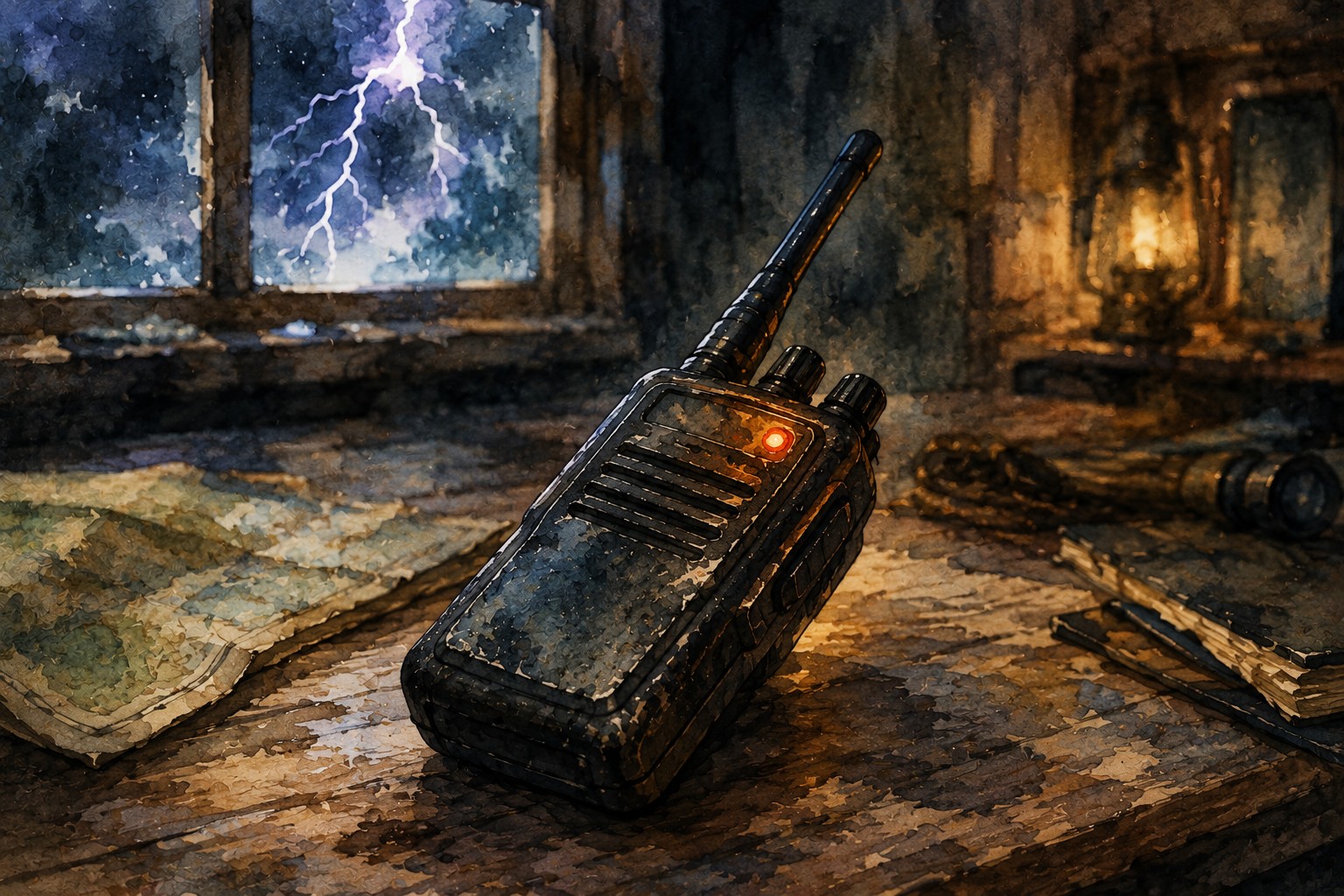
The night was heavy with rain, each drop striking the ground like drumbeats. Leon’s legs burned as he sprinted across the wet earthen floor, the echoes of voices chasing him down still clawing at him. He had barely escaped the robbery gone wrong; the screams, the grip of a hand on his shoulder, the panic, the tiresome chase. Now he was running blind, desperately searching for shelter. Leon’s breath came in ragged bursts, each inhale scraping his dry throat raw. Twigs snapped beneath his feet and rogue branches left red trails on his arms in their wake.
He stumbles, nearly losing his balance and slumping into the mud that clung to his shoes like hands trying to drag him down. Then, through the curtain of rain, he noticed a cabin; its roof sagged, its walls bowed, yet it refused to break apart, standing like a forgotten survivor. Leon pushed forward, each step a battle against exhaustion. The cabin loomed closer like a sanctuary in the midst of war. The door was swollen with damp, its wood splintered; but Leon shoved it open with a grunt. The hinges shrieked and the scent of moss welcomed
him.
The place was visibly abandoned, yet not entirely lifeless. Broken chairs lay toppled, their legs jutting like bones.
Cobwebs hung in the corners, trembling faintly with the air that followed him in. Leon unwillingly dragged himself deeper, his chest still heaving from the chase as he caught his breath. He pressed his back against the wall then closed his eyes, only to be interrupted by a gush of wind that shattered the window open. A shard jabbed his right leg, making him scream out in agony. Leon pressed his hand against the wound, the damp
crimson warmth seeping through his fingers. The pain was sharp, immediate, but what unsettled him more was the silence that followed his scream.
The cabin seemed to swallow the sound whole, as if it had been waiting for it. A chill draft curled through the broken window, carrying with it the scent of wet earth and something faintly metallic. The air pressed close and heavy, as though the cabin itself was listening.
Leon limped towards the cabinet, each step sending a painful throb through his leg. The dim light creeping in through the broken window revealed a cabinet lined with forgotten supplies. His eyes caught the outline of bandages, yellowed but still neatly folded. He reached for them with trembling fingers and wrapped them clumsily around the wound. The sting eased slightly, though the ache remained. Leon exhaled, settling
down into the chair and calling it a day.
The storm outside pressed against the cabin walls, its rhythm steady, relentless. Inside, the silence was heavier, almost deliberate, as though the place had swallowed his scream and now waited for something else. His eyelids drooped, exhaustion dragging him down, but the faint hiss of static from somewhere in the room teased at the edge of his hearing. Leon dismissed it as the wind, shifting uneasily in the chair. Yet, the sound remained.
The cabin grew quiet again, except for the faint static sound echoing through the empty space. Suddenly, the hiss returned, sharper, more insistent. Leon frowned, his back straightening, eyes darting toward the shelf.
A walkie-talkie.
It sat there, battered yet alive with noise. Leon stood up abruptly, the chair scraping against the floor. He limped is way towards the shelf and reached out for the dusty and old walkie-talkie. With a quick breath, he blew across its surface, sending a thin veil of dust spiralling into the air. The device felt heavier than it looked, its cold casing burying itself into his palm. Soon, the static returned; faint but noticeable.
“Hello?” Leon’s grip tightened. He pressed the button again.
“You hear me now, don’t you?” the voice came from the walkie- talkie.
“Who are you? What is this?”
“A truth buried deep, a secret yet to unfold; a factory’s fire, a story untold.”
“What secret? What fire? Who are you?”
“You still don’t know? Looks like I owe my guest a littleintroduction.”
“Guest?” Leon scoffs. “I didn’t ask to be here.”
“Not everything satisfies our wishes. Darkness taught me what you’re yet to understand.”
“You’re not making any sense.”
“Sense is for the living. I am what remains. A boy once bound to iron and flame.”
Leon stops for a while, trying to regather his thoughts and figure out what the voice was trying to convey.
“So, you’re a boy? Who met an accident?”
“Accident? Perhaps. Forgotten? No. Now you carry the channel that lets me speak.”
The voice disappeared.
Leon lowered the walkie-talkie slowly, his knuckles white against its casing. His breath came uneven, the ache in his leg pulsing in rhythm with the faint crackle that lingered in the device. He wanted to believe it was over, that the storm had played tricks on his ears. But the silence pressed too close. The storm was over and he decided to leave for a good night’s rest.
Next morning, Leon woke up with a start. Pale sunlight peeked through the blinds as his legs throbbed from yesterday’s adventure. Yet, it wasn’t the pain that woke him up.
“Good morning, guest.”
His eyes snapped open. The walkie-talkie sat on the chair beside him, though he didn’t remember bringing it there. He didn’t even remember keeping it. Yet there it was, waiting, its casing dull but alive with static.
“No, this can’t be. I left you on the shelf.”
“Shelves are for the forgotten, guest. You can’t forget me now.”
“What do you want from me, boy?”
“Just your ears, for now. Or maybe your brain too if you want to truly understand me.”
“Understand you? You’re nothing but a… a ghost in a machine, perhaps.”
“Ghosts don’t bleed, ghosts don’t burn; I wish I could too, because ghosts do run.”
Leon’s stomach tightened.
“Run? From what?
“From the fire, from the lies, from the smiles of the men who promised I would certainly be alright.”
“You’re saying… You trusted them, and they let you burn?”
“Trusted, yes. Believed their words, their promises of safety.
But safety was cheaper broken. And I burned.” “That’s not possible. Accidents happen.”
“Accidents do not sign papers; accidents do not cut corners. Men who smiled while the gears screamed certainly do.”
The words hung heavy in the room, each syllable dragging Leon deeper into the weight of the boy’s demise. The statis softened, almost like a sigh.
“Seems like I’ve spoken a lot, haven’t I?”
“You… certainly have.”
“Tell me a bit about yourself.”
“Myself?”Leon blinked, caught off guard. He had expected more riddles, more cryptic fragments of fire and iron. Instead, the boy’s tone was lighter, almost conversational.
“M-me? I don’t see why that matters.”
“Yes, it matters. You carry the device that lets me speak, I need to know who I’m being carried by.”
Leon gulped, the dryness in his throat betraying the unease that had been building since the night before. The walkie-talkie hummed faintly in his hand, the boy’s words lingering like smoke.
“Well, I… I take what doesn’t belong to me and… and resell it.
I never thought it was a big matter. Just scraps, just pieces.”
“Scraps? Pieces? That’s what they called me too. And when the fire came, I was discarded.”
Leon’s breath caught. The words pressed against him like a weight, heavier than the walkie-talkie in his hand.
“Discarded… like you didn’t matter.”
“Matter? I was fuel. I was profit. But when the flames rose, I was ash. And ash doesn’t matter to men who count coins.”
“You’re saying… they knew?”
“They didn’t just know, Leon. They betrayed my trust. But perhaps, you’re yet to understand the pain.”
The voice exhaled deeply.
“That’s enough for now, guest. You’ve listened to me, and that’s all I needed this morning.”
Leon sat frozen, the walkie-talkie warm against his palm. The hiss dissolved into silence. The room was still, but Leon felt the words lingering in the air, clinging to him like smoke. He set the walkie-talkie down, though his hand trembled as he did. The room became silent, as if the walls themselves leaned in, eager to read his thoughts. He rubbed his temples, whispering to himself, “Scraps, pieces, discarded… What have I gotten myself into…” His pulse thudded in his ears. He tried to steady his breathing, but each inhale carried the weight of the boy’s voice, each exhale felt like surrender.
The morning light crept across the floorboards, simple and ordinary, yet it felt strange to him. He forced himself up to wash his face. The cool water bit into his skin, reminding him of the chill he felt at the boy’s words. He poured milk and cereal into a bowl, stirring absent-mindedly. Each bite felt mechanical and tasteless as his thoughts clawed at his appetite.
Leon forced himself to comply and finish the bowl, each spoonful heavy and tasteless. The milk had gone lukewarm, the cereal soggy, but he kept eating until the porcelain was bare.
Leon stepped outside for a fresh breath of air. The wind was warm, carrying with it the scent of rain and damp earth. The streets were quiet, neighbours bent over their gardens, trimming hedges and watering plants, while children darted past with laughter that belonged to minds far lighter than his own. He walked slowly, his hands buried deep in his pockets, shoulders slumped as though the weight of the morning still clung to him. The warm rays of the sun painted the world in a shadow of gold; leaves shimmering, rooftops glowing, even the puddles from last night’s rain catching the light like fragments of glass.
Leon wondered what it would feel like if the boy were here, if the boy lived. The thought pressed against him as he walked on the green grass beneath the golden hue. He imagined a shadow at his side, small footsteps keeping pace with his own. Perhaps the boy would laugh at the way the wind ruffled his clothes, dart off to play with the children of the town, or point upward with wide eyes at the shapes of the clouds. Leon could almost
hear the endless stream of questions. “Why are spiders yellow in yellow flowers?” he might ask, his voice bright with wonder and amazement. Leon’s chest tightened at the thought. It was both comforting and mournful. Comforting because he could feel the little shadow following him around, hear his voice in his own minds, yet mournful because what is gone can never come back.
Leon’s steps slowed.
He clenched his fists in his pockets. If the boy had lived… if he had walked beside me… The thought twisted into a resolution. “I will not let this rest.” He declared without hesitation. The walk became heavier, each step a vow. The ordinary day; the gardens, the laughter, the golden hue, all seemed to mock the truth he carried. Leon no longer felt like a man drifting through routine. He felt like a man sharpening himself against grief. His decision was clear; not with words, not with denial, but with actions.
In the evening, Leon sat hunched over the walkie-talkie, desperation etched into his face. The room was dim except for the moonlight peeking through the windows, shadows stretching long across the walls. The silence pressed against him like a weight.
He pressed the button tirelessly, his voice demanding answers. “Talk to me please, I understand now.” The walkie-talkie hissed back, empty and unyielding. Each time it crackled faintly, teasing him with the possibility of a reply. Yet no voice answered. Leon’s breathing grew uneven, his forehead damp with sweat. He stared at the device as though sheer will could summon the boy’s voice back from the static.
“Guest?”
The walkie-talkie came alive.
“No one… no one really listens to me on their own, you know? They only hear when they’re forced. But you… you called.”
“Well, I understand what you meant. And I need answers.”
“Answers, precious answers, all demand; you seek the light, yet truth slips like grains of sand. You seek the light, but shadows remain; will you still choose the darker way?”
Leon took a deep breath.
“I don’t care how heavy it is. I’ve carried silence long enough.
Tell me what happened. Tell me why you were discarded.”
The voice sighed deeply.
“I was a mere spark in the dark, a candle too small for the storm; yet perfect to blame, a scapegoat for the night. Flames engulfed me like hungry monsters, the air stabbed my lungs with knives; I was swallowed whole by fire, everyone saw the smoke, yet no one heard the silence I left behind.”
“Who were they? Do you remember their appearances?”
“They wore boots. Heavy, black ones; thick soles that struck the ground like hammers. I remember the sound more than their faces.”
“Interesting, I’ll remember that.”
The walkie-talkie becomes silent again, except for the faint crackling. Leon now knows a key information, and he’s hell- bent to find out who these men are. With this starts his hunt
to become a voice for the discarded.
The next day, Leon’s hunt begins with a quiet ferocity. His jacket, blue as the ocean, lets him dissolve into the crowd like ice vanishing in water. He moves unseen, but his eyes remain sharp, scanning every beat of the streets. His eyes narrow as he searches for the heavy, black and stitched boots.
Leon’s shoulder brushed against a man’s, a collision which abruptly distracted Leon from his findings. The contact was brief, but it carried weight. The man glanced at him, suspicion evident in his eyes. Yet, Leon remained calm and unreadable.
“Ey, boy? Don’t ya’ look where ya’ go?” His voice was rough as he spoke from years of barking commands. He stepped closer.
Thud.
War drums.
Each echo is a verdict, each step a sentence, just like the boy said. Leon held his ground, calm and unreadable, his ocean-blue jacket rippling faintly in the breeze. He let the man’s words hang in the air, studying him; the boots, the posture, the arrogance. Every detail was a mark; every gesture was a clue. “My bad, won’t happen again.” Leon said, unflinching. “Better not, or it won’t be pleasant for either of us.” The man’s boots thudded away, suspicion still etched in his eyes. Yet Leon’s calmness was a mask. Beneath it, he had already marked everything, carving the man into his memory. The leather, the seams, the arrogant stance. Each sign was a silent tally in his hunt. The crowd flowed around them, different. Leon knew this was the first step, and now he couldn’t back away. The boy’s voice had given him the map, and the boots had given him the trail. From here, every encounter would be a stitch in the tapestry of vengeance, every mark a thread pulling him closer to revealing the truth.
Leon walked to his home, the door closing behind me. The silence of his home wrapping around him like a blanket. He barely had time to breathe before the walkie-talkie whispered, “I saw you. With him.” It wasn’t an accusation. Rather, it was recognition.
“Hm? What about it?”
“You marked him, didn’t you? He’s the first. Don’t falter now.”
With that, the walkie-talkie went silent, confirming Leon’s assumption.
In the cold breeze of the night, he approaches the factory ruffled in an oversized sweater and a knitted mask, ensuring no one remembers any details if spotted. The gates remain locked, guards patrolling. But Leon knows the rhythm of breaking in, he has done it countless times. He waits, listening to the boots of the patrol echo against the iron fences. When the sound fades, he slips forward. A rusted ladder clings to the side of the wall like a forgotten bone, and Leon climbs swiftly, each step creaking under his weight. At the top, Leon pauses, crouched low, the knitted mask damp against his breath. From the terrace, he spots a guard stationed at the gate of entry; broad-shouldered, rifle slung lazily, but eyes sharp. The guard’s boots strike the ground in a steady rhythm, each thud echoing through the night air. Leon studies the pattern, memorizing the intervals between the guard’s pacing and the brief moments when his gaze drifts. When the sound of the patrol’s boots disappears slowly into the night, Leon sprints toward the gate, heart pounding, only to find it locked tight. He curses under
his breath, fingers brushing the cold iron, ready to retreat into the shadows.
“Ay, boy!”
The shout cuts through the silence, sharp as a blade. The guard has spotted him. The thud of boots grows louder, closing in from both sides. Leon looks back; a multiple-storey drop yawns behind him. He is cornered. The guard unges, rifle raised.
Leon ducks low, sweeping his leg against the ground. The man crashes down, his knees smashing against the cold floor. Without hesitation, Leon twists his hand, driving his shoulder into the guard’s jaw with brutal precision. The crack echoes, and the man slumps unconscious, out cold for a long time.
Leon’s eyes catch the faint glint of metal; a key dangling from the unconscious guard’s pocket. For a moment, the chaos around him fades, replaced by the sharp clarity of opportunity. He tugs the key free before the second guard can close in. The metal is cold in his palm, heavy with promise. The locked gate is no longer a barrier; it’s an invitation. He slips into the factory unnoticed. The air was thick with dust and the faint stench of oil. He moved through the corridors like a phantom.
At the bottom, Leon discovered a cramped records room — a forgotten archive tucked behind rusted doors. He rushed down the narrow stairwell, shelves looming on either side, their wood warped with age. He reached for a stack of papers, blowing gently. A thin mask of dust lifted into the air. Beneath it, the documents revealed their yellow, brittle pages.
The words were damning.
Leon’s breath caught as he flipped through the brittle pages, each one a ledger of cruelty disguised as order. Reports of “accidents” filled the margins, a boy’s hand crushed in the gears of a loom, a girl suffocated in smoke when the exits were locked. Each tragedy was neatly filed away, stamped “resolved” in bold ink, though no resolution had ever come for the mourning families. The documents were yellowed, their edges curled, but the crimes they carried were fresh, raw, and undeniable. Numbers bled across the pages: hours worked, wages stolen, lives extinguished. Yet, no one saw the pain.
This needed to stop.
He stuffed the documents into his satchel, careful not to tear the fragile pages. Each sheet was a weapon, sharper than any blade. The factory’s walls seemed to close in, heavy with the ghosts of those who had laboured and met their demise here.
Leon knew it wasn’t just about vengeance for a single soul anymore, it was exposing a whole system. He sneaked out of the factory and went to his home, his satchel heavy with evidence. The weight of those yellowed papers felt heavier than iron; every name, every “accident,” every stolen childhood pressed against him. Leon mmediately began searching for a light that could ignite the spark of rebellion. Leon understood that evidence alone was not enough; it needed a platform, a voice that could pierce through the walls of power.
Like embers in the dark, two names emerged.
Michael Turner, a veteran of the underground press. His pen was sharper than any blade. Turner had once dismantled a series of corruption and negligence; each article had become a hammer blow against the system. He was relentless, a man who thrived on danger and carried scars from battles fought with words.
Sarah Whitemore, a fierce and uncompromising figure. Her voice echoed through the pages of outlawed journals. She worked to expose scandals others dared not touch, weaving cases that exposed crimes never noticed. Her refusal to bend and her ability to turn truth into fire let her shine.
Leon reached out desperately, raw urgency vivid in his voice. He sent messages through channels; letters folded into secrecy and encrypted platforms of texts. For days, silence pressed back against him.
They finally answered.
“If this is what you say it is, then I’m hands down to burn them awake.” Michael’s reply was sharp, no hesitation.
“Hell, I’ve been waiting for something like this. Keep me informed, this is going to be a ride.” Sarah’s reply was filled with anticipation of bringing truth to glory, what she does best.
Relief surged through Leon. The evidence was no longer just his burden; it had found voices strong enough to carry it into the light.
Soon, their words ignited furious rebellion. Michael Turner published document after document in the underground press, each revelation hammering the nail of truth into the board of corruption. Sarah Whitmore gave voice to the voiceless, her sharp prose cutting through the silence that had smothered the city for years. The factory that had thrived on secrecy suddenly faced a storm. Workers refused to enter its gates, mothers pulled their children away from the machines and entire communities rallied together in defiance. The boycott spread
like wildfire; shops stopped selling goods tied to the industry, unions called for strikes and mass protests filled the streets with chants of justice.
Even the digital world joined the uprising. Netizens flooded forums and social platforms with critiques of the damning evidence, amplifying the outrage until it became impossible to ignore. Michael’s relentless publications and Clara’s fiery speeches spread beyond the city, carried by whispers and the roar of protests. The Government, pressed by the fury of the people, launched investigations. Executives were dragged into courtrooms, their crimes laid bare under the same light Leon had once uncovered in the dusty archives. The yellowed,
hidden archives now sat on the bench of the judge. The trials became spectacles. Crowds gathered outside the courthouses, holding banners with the names of the forgotten children. Journalists filled the galleries, pens scratching furiously as every detail was revealed; locked exits, false reports, wages stolen, “resolved” marks.
The squirmed under questioning, their polished suits unable to shield them from the weight of the evidence. Every page Leon had carried from the factory now spoke louder than their denials and excuses. The industry’s empire crumbles; not under fire or steel, but under the relentless power of memory andcollective rage. With the executives disgraced and the documents exposed, production lines ground to a halt. Workers refused to return, suppliers severed ties and the boycott drained the industry of its lifeblood. Eventually, the gates were locked not by guards but by silence; the machines stood still, their smoke stacks cold.
The factory shut down as truth came to light.
Once branded a thief, sneaking through corridors and stealing, he was now seen as a liberator. The satchel became the very symbol of justice. His life shifted from shadows to light. No longer a phantom slipping through rusted doors, Leon became a figure of resistance. He had become a thief to witness, from an outlaw to a hero.
He returned home, the air warmer than usual, as though the city itself had exhaled after years of suffocation. Leon set the satchel down gently, no longer a burden but a relic of victory.
He lifted the walkie-talkie to his lips, his voice trembling with relief and pride.
“We did it.”
“We did what?”
“We stopped them. We unsured no one suffers any longer like you did.”
“We… stopped them? We?”
Leon closed his eyes and exhaled. He smiles faintly, understanding the boy couldn’t imagine being a part of
something so vast. His world was small, just like he was. “Yes, we. You reminded us why we fought. Without you, therewould have been no reason to keep going.”
“So, I helped?”
“More than you’ll ever know.”
The static hummed, but beneath its Leon could almost hear the boy’s smile; fragile, uncertain, but real.
“I was trapped in those walls, my name in the documents. I thought no one would remember me. But you did.”
Leon’s grip tightened on the walkie-talkie.
“Thank you, Leon.”
And with that, the walkie-talkie went silent forever.
The silence that followed was not emptiness; it was peace. The boy’s final words echoed in his mind, not as sorrow but as release; a soul set free, a story finally remembered. Leon sat in the quiet warmth of the night, the walkie-talkie in his hand; and for the first time in forever, he felt peace; true peace at freedom of the spirit who will forever be a part of him.

What is Riddles for The Damned about?
Riddles for The Damned is a suspenseful mystery story about Leon, a thief who takes refuge in an abandoned cabin and discovers a mysterious walkie-talkie connected to the spirit of a boy who died in a factory fire.
Who is Leon?
Leon is the story’s protagonist. After a failed robbery, he stumbles into an abandoned cabin, where his encounter with a supernatural voice forces him to confront both a forgotten tragedy and his own moral choices.
What is the significance of the walkie-talkie?
The walkie-talkie serves as the bridge between Leon and the mysterious boy, allowing the spirit to reveal cryptic riddles, painful memories, and hidden truths.
Is Riddles for The Damned a ghost story?
It blends supernatural horror with mystery and psychological suspense. While a ghostly presence drives the plot, the story also focuses on real human failures and moral responsibility.
What age group would enjoy this story?
The story is best suited for young adults (13+) and teen readers who enjoy mystery, suspense, paranormal fiction, and psychological thrillers.
What makes Riddles for The Damned unique?
Its combination of eerie atmosphere, cryptic dialogue, emotional storytelling, and a mystery rooted in social injustice creates a compelling blend of horror and human drama.
Who are Michael Turner and Sarah Whitmore?
Michael Turner is a fearless investigative journalist, while Sarah Whitmore is an uncompromising writer and activist. Together, they help expose the factory’s crimes and rally public support for justice.
What is the central message of Riddles for The Damned?
The story shows that truth, courage, and compassion can overcome corruption, and that remembering forgotten victims is the first step toward justice.
Why does the walkie-talkie become silent forever?
Its silence symbolizes closure. The boy’s spirit no longer has unfinished business because the truth has been revealed and justice has finally been served.
Where can you buy the books?
You can buy the books at Bookosmia.com and Amazon.in
Mohini Made Friends I Children’s Book About Friendship and Dance
Follow Mohini, a little girl who communicates through dance and hand gestures. She is shunned as no one seems to understand her, but she finally finds the beautiful magic of friendship. The book is an attempt to bring children, and elders alike, to the captivating story of mohiniyattam through creative non-fiction. This book, Published by Bookosmai, celebrates the rich cultural heritage of Mohiniyattam and its journey from obscurity to recognition, with beige, black, and yellow illustrations representing the dance’s costume. All through a little girl and her simple world. Get your copy now and join Mohini on her enchanting journey! Authored by: Shruthi KP Illustrated by: Rohit Bhasi A4 size.

This article is published by Bookosmia, India’s #1 publisher for and by young people. Bookosmia publishes stories, books, podcasts, events, TED-Ed talks, workshops, bedtime stories and more related to kids and young adults.
Photo Credit – AI generated images from Chat GPT and Magic Media from Canva .
Want to publish your articles, reviews, stories, audio stories, bedtime stories and poems ?
Did you know that children can submit audio stories to be turned into Bedtime Stories and published on Bedtime Stories – A Podcast by Bookosmia?
Write to us at sara@bookosmia.com or submit your article at the link below
Get Published