Dubai’s inclusive education framework is notable for its clarity, enforceability, and systems thinking. Unlike broad policy intent, Dubai mandates who is responsible, how frequently actions occur, and what structures must exist. Schools are required to appoint leaders and coordinators trained specifically to operationalise inclusion, not merely endorse it. The compulsory Inclusion Support Team (IST)—with principals, SEND leaders, support teachers, parents, and even students—ensures inclusion is not an individual teacher’s burden but a school-wide accountability model. Weekly meetings, time-bound monitoring, and accredited alternative curriculum pathways make inclusion measurable and actionable rather than symbolic.
The strict implementation by the government of the plan is backed by the monitoring done to keep in check also the inclusion and well being, these two parameters in fact are assessed by experts from the UK and USA, sparing no room for leniency.
NEP 2020 and Dubai’s policy share a common philosophy: inclusive education as a right, not charity. Both emphasise teacher training, accessible classrooms, assistive technologies, and non-discriminatory pedagogies. NEP’s proposal to revise the B.Ed. The curriculum to include inclusive education mirrors Dubai’s insistence on continuous professional development for teachers and leaders. Additionally, NEP’s focus on aids, devices, and equitable participation aligns with Dubai’s provision of support teachers, learning support assistants (LSAs), and alternative learning pathways for students with SEND.
India’s biggest gap is ambiguity in implementation. NEP 2020 acknowledges the need for
pedagogy, and inclusive environments—but no clear mention of which pedagogical models, or
how environments should be transformed. There are no mandated structures like Dubai’s IST,
no regular monitoring cycles, and no clarity on outcome measurement. Revising the B.Ed.
curriculum is necessary but insufficient without —learning support assistants (LSAs), dedicated
teams, in-school specialists, assistive infrastructure, and parental education mechanisms
embedded into daily school functioning.
In Dubai, each school must have inclusion in their vision or mission, no child is to be denied
admission because of their disability.
India must move from policy vision to operational design. This includes mandating school-level inclusion teams, defining assistive technologies and support roles, setting monitoring timelines, and recognising neurodiversity explicitly within law and practice.
Inclusion must be treated as a system responsibility, not an individual adjustment like to change societal perception from limitations to capabilities; kids with special needs are called students with determination and not disabled students. This step is well acknowledged world wide.
Immediate actions are taken against any violence done to these students inside school or home, with the involvement of police and government once reported by the parents or school authorities respectively.
Let’s look how both India and Netherlands have been doing so differently with respect to context
of the legal frameworks made for inclusion in classroom learning:
The difference lies not in intent, but in translation of rights into enforceable systems. Both countries recognise education as a fundamental right under the UN Convention on the Rights of Persons with Disabilities (UNCRPD). India’s RPwD Act (2016) and the National Education Policy (NEP 2020) explicitly mandate inclusive education, aligning in principle with child-centric and rights-based frameworks seen in countries like the Netherlands.
However, the Netherlands embedded this right into binding school obligations, funding mechanisms, and institutional restructuring as early as the 1980s–1990s. India, while progressive in legislation, has largely remained at the level of rights declaration rather than rights delivery.
The Netherlands’ legal framework operationalises inclusion through clear mandates and financial accountability:
● The Compulsory Education Act (1969) legally binds every child to schooling until at least age 16, ensuring no discretionary exclusion.
● A weighted funding system (2006) allocates additional resources based on parental education levels, directly linking socio-educational disadvantage to staffing and support capacity.
● Special schools for learning and behavioural difficulties were legally restructured (1998)—either merged with mainstream schools or converted into practical training or expertise centres.
● The Expertise Centres Act (1998) created Regional Expertise Centres (RECs), institutionalising specialist knowledge within districts.
● The landmark “Backpack Policy” made funding pupil-bound, empowering families to choose mainstream or special schools and co-decide how funds address the child’s needs. These laws specify who must act, how resources move, and where accountability sits.
India has enacted several important laws—RTE Act (2009), RPwD Act (2016), and schemes under Sarva Shiksha Abhiyan and Samagra Shiksha—but outcomes remain uneven not due to absence of mandate, but due to fragmented implementation structures.
While NEP and RPwD mandate inclusion, India operates through multiple parallel education boards—CBSE, ICSE, State Boards—each with its own curriculum standards, assessment norms, and compliance mechanisms. This decentralisation makes uniform enforcement of inclusion obligations structurally difficult.
Unlike countries such as the Netherlands—where a largely unified national curriculum and school governance system allows inclusion laws to translate directly into practice—India’s legal provisions lack:
● mandated school-level inclusion structures uniformly across boards,
● pupil-linked or needs-weighted funding models,
● legally required specialist support systems embedded within districts,
● and measurable, board-agnostic inclusion outcomes.
This Blog is written by Akshita Yadav
Akshita Yadav is an 18-year-old undergraduate student from Nagpur, currently pursuing a Bachelor of Business Administration (BBA) at the Indian Institute of Management Bodhgaya (IIMBG). She has a keen interest in public policy and strategy, with a particular focus on neurodiversity and allied social policy domains. Akshita aspires to work in policy research and contribute to the nation’s think tanks through policy notes, strategic analysis, and inclusive governance frameworks.

What makes Dubai’s approach to inclusive education different from many other countries?
Dubai’s framework is highly structured and enforceable. Schools must appoint trained inclusion leaders, form an Inclusion Support Team (IST), conduct regular monitoring, and provide accredited alternative pathways. Inclusion is treated as a whole-school accountability system rather than an individual teacher’s effort.
What is an Inclusion Support Team (IST) in Dubai schools?
An IST is a mandatory school team that includes the principal, SEND leaders, support teachers, parents, and sometimes students. The team meets regularly to monitor inclusion practices, student progress, and ensure time-bound action plans are implemented.
How does Dubai monitor inclusion and student wellbeing in schools?
Dubai’s government enforces inclusion through regular monitoring and inspections. Inclusion and wellbeing are evaluated by experts, ensuring schools follow structured, measurable practices with little room for leniency.
How does Dubai’s inclusion policy align with India’s NEP 2020?
Both frameworks view inclusive education as a right. They emphasise teacher training, assistive technologies, accessible classrooms, and equitable participation. NEP’s proposal to revise B.Ed. curriculum for inclusion reflects Dubai’s focus on continuous professional development.
If NEP 2020 supports inclusion, what gaps remain in India’s implementation?
The main gap is operational clarity. NEP mentions inclusive environments and pedagogy but does not define specific school structures, monitoring systems, support roles like LSAs, or measurable inclusion outcomes across all boards.
What can India learn from Dubai’s inclusive education system?
India can adopt school-level inclusion teams, defined support roles, regular monitoring timelines, assistive infrastructure, and clearer accountability. Inclusion should be a system responsibility embedded in daily school functioning.
How does terminology like “Students of Determination” impact inclusion in Dubai?
The term shifts perception from disability to capability, promoting dignity and changing societal attitudes toward children with special needs.
How do India and the Netherlands differ in implementing UNCRPD for education?
While both signed UNCRPD, the Netherlands translated rights into enforceable school obligations, funding models, and institutional restructuring. India’s approach remains largely at the level of rights declaration rather than structured delivery.
What legal mechanisms in the Netherlands make inclusion enforceable?
Key laws include the Compulsory Education Act (1969), weighted funding system (2006), restructuring of special schools (1998), Regional Expertise Centres (RECs), and the “Backpack Policy” where funding follows the child.
What is the “Backpack Policy” in the Netherlands?
It is a pupil-bound funding model that allows families to choose mainstream or special schools and decide how allocated funds support their child’s needs.
Why have India’s RTE Act, RPwD Act, and NEP not produced uniform inclusive outcomes?
India’s decentralised system across CBSE, ICSE, and State Boards makes uniform enforcement difficult. There are no mandated inclusion structures, needs-based funding models, or board-agnostic measurable outcomes.
What is the key lesson for India from global inclusion models?
Moving from policy vision to operational design—clear roles, funding linkage, monitoring cycles, specialist support systems, and enforceable school responsibilities.
Where can I buy the book – Dhwani?
Dhwani is an inclusive, mindfulness-based initiative designed to support the emotional well-being of teachers and students while fostering truly inclusive classrooms. Rooted in research from education, psychology, and neuroscience, Dhwani recognizes a simple truth: regulated teachers create safe, inclusive learning spaces.
At its core, Dhwani focuses on self-regulation, awareness, and emotional literacy. The curriculum equips educators with practical tools—such as grounding exercises, breathing techniques, and reflective practices—that can be used in real classroom moments, not just in theory. These tools help teachers respond with curiosity rather than control, and empathy rather than assumption.
Dhwani believes inclusion is not a checklist or a one-time intervention, but an ongoing journey. By supporting teachers’ mental health, Dhwani helps reduce burnout, unpack unconscious bias, and build resilience—making inclusion sustainable rather than exhausting.
Through simple, age-appropriate practices, Dhwani also empowers students to understand their emotions, feel safe, and stay engaged, creating classrooms where every child is seen, valued, and supported.
In essence, Dhwani begins with the teacher’s well-being—because inclusion starts from within.
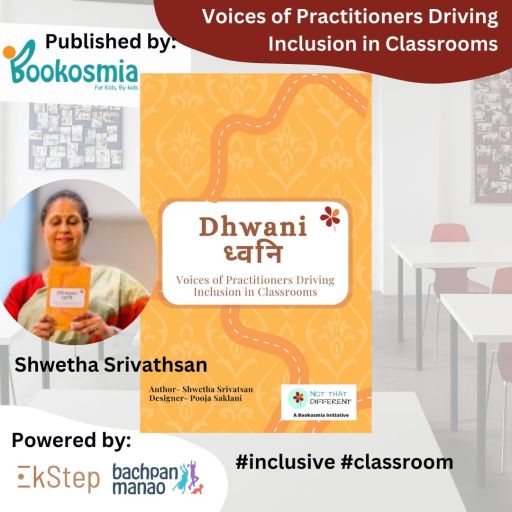
Dhwani I Voices of Practitioners Driving Inclusion in Classrooms
https://bookosmia.com/teachers-mental-health-inclusive-classrooms/