Welcome, dear reader! Today, we discuss one of my favourite topics: Diwali!
Let me start off with a personal note on Diwali, or what we call Deepavali down south! I come from a family that absolutely goes all out for Deepavali. On Deepavali, we wake up early. We can barely even open our eyes, and our hair is a mess from our deep slumber. We sit in front of God, with our eyes closed as the parents rub oil into our skin. We are then pushed into the washrooms and given extra instructions to scrub our skin clean.
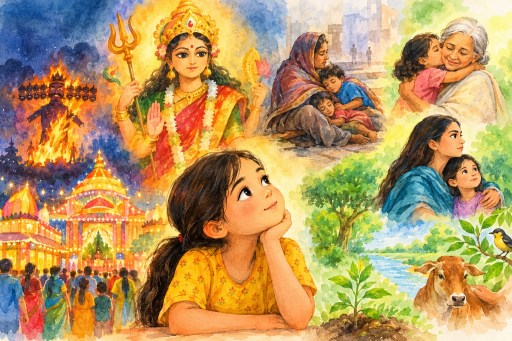
During the whole hubbub, we are told the story of Naraka Chaturdashi, the day Lord Krishna defeated the mighty demon Narakasura. According to the legend, Narakasura, the son of Bhudevi, had grown tyrannical and wreaked havoc across the heavens and the earth. He imprisoned thousands of women and stole the earrings of Aditi, the mother of the gods. Unable to bear his atrocities any longer, the gods sought Lord Krishna’s help. Krishna, accompanied by his wife Satyabhama, went to war against the demon. In the battle that followed, Satyabhama played a crucial role in Narakasura’s defeat, and Krishna ultimately slayed him. Before his death, Narakasura is said to have wished that his demise be celebrated with joy and light rather than sorrow. Thus, Naraka Chaturdashi came to be associated with the triumph of good over evil, and the ritual of applying oil and bathing before sunrise became a symbolic cleansing and celebration of this victory.
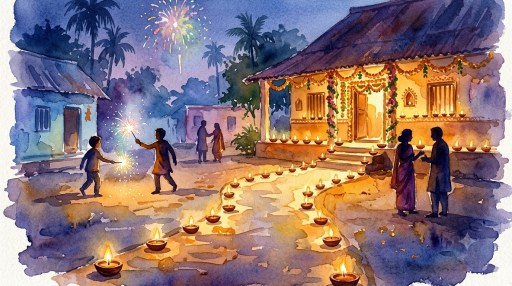
Now, the whole house smells like sandalwood and mustard oil. The women are decked in their best sarees, gleaming at their squeaky-clean children, who are beaming at the prospect of bursting the firecrackers they were promised.
After a round of photos taken from various different angles, our parents finally release us from their tight grasps. We run with bouts of energy that have never been seen before. One of us grabs a gun pataki and starts aiming at the other, before the other grabs her gun! Tring! There goes the pooja announcement! All of us must assemble in front of the pooja room once again!
We are then asked to eat. We protest, but once we smell the gulab jamun, we realise how hungry we are. We quickly eat and plan to continue our warfare. As the clock strikes three, the whole house is quiet. We, the mighty soldiers who promised war, are sleeping, curled up on our mothers’ laps.
After drinking our hot evening beverages and a quick round of UNO, we are finally prepared for the long-awaited battle. We grab our sparklers and Lakshmi bombs. There is a loud boom! The older kids have bought the 500-skyshot crackers. Ouch! Our necks begin to hurt while we watch the colours light up the sky.
The day ends with a round of vanilla ice cream and hot jamun. This has always been Deepavali to me.

Diwali is not just a one-day event. If you ask my mother, it is a month-long affair. The cleaning begins a month earlier! Trust me, I know. The first day of Diwali is called Dhanteras, which is associated with prosperity and good fortune. On this day, families pray for success and prosperity. If you see your parents leaving the house, chances are they are off to purchase gold and silver, which are traditionally believed to bring good fortune!

The second day is a personal favourite: Naraka Chaturdashi. The story of Krishna and Narakasura is one of my favourite tales. I also feel extra clean after the oil baths I am forced to take! The whole house is lit up with new lights and even the old ones that are only brought out for Diwali.

Day three brings us to Lakshmi Puja, when families seek blessings for happiness, wealth and prosperity. The whole neighbourhood seems to have a silent competition going on. Who has the prettiest decorations? Who has the best diyas? And, finally, who has the best crackers? Every house seems to be putting its best foot forward!

The fourth day is celebrated as Govardhan Puja, also known as Annakut. It commemorates the story of Lord Krishna lifting the Govardhan Hill to protect the villagers of Vrindavan from the torrential rains sent by Lord Indra. The day is marked by the preparation and offering of elaborate meals, symbolising gratitude for nature’s abundance and the blessings of sustenance.

Finally, we arrive at Bhai Dooj, the fifth and final day of the festivities. Dedicated to the beautiful bond between brothers and sisters, this day holds a special place in my heart. Although my brother and I fight throughout the year, on this day, we pray for each other’s protection and happiness!
And just like that, five days of festivities, prayers, food, family and togetherness come to an end, leaving behind memories that we eagerly wait to recreate the following year.
As much as I love the excitement of bursting crackers and watching the night sky light up, I think it is important to pause and consider the kind of Diwali we want to celebrate. As the years have passed, we have understood the detrimental impact of crackers on animals and air quality. While traditions hold a special place in our hearts, it is equally important to make room for more mindful ways of celebrating them.
A greener Diwali does not have to mean a quieter or less exciting one! We can light up our homes with traditional diyas, reuse decorations, make beautiful rangolis, share homemade sweets, and spend time with our families. We can also be mindful about the number of crackers we burst, choose community celebration – burst crackers with neighbours, reduce the number of loud crackers, and clean up the space after we are done playing.
I don’t think celebrating responsibly means taking away the fun of Diwali. If anything, it gives us another reason to celebrate: knowing that our happiness does not have to come at the expense of someone else’s. After all, the festival is about light, joy and togetherness.
Note: This Article is written by Sanjana. She is a psychology student at Christ University with a penchant for analyzing people and capturing their core essence. A literature enthusiast powered by caffeine and good conversations, she finds deep meaning in the most mundane moments. When she’s not reading or observing the world around her, she’s usually taking the scenic route to tell a good story.

1. What is Diwali and why is it celebrated?
Diwali, also known as Deepavali, is the Festival of Lights. It symbolises the victory of good over evil, light over darkness, and knowledge over ignorance. It is celebrated with prayers, diyas, sweets, decorations and family gatherings.
2. Why is Diwali also called Deepavali?
The word Deepavali comes from Sanskrit, meaning a row or series of lamps. People light diyas to welcome happiness, prosperity and positivity into their homes.
3. What are the five days of Diwali?
The five days of Diwali are:
4. What is the story behind Naraka Chaturdashi?
According to Hindu mythology, Narakasura was a powerful demon who troubled the gods and people. Lord Krishna, accompanied by his wife Satyabhama, defeated him. The day celebrates the triumph of good over evil.
5. Why do people take an oil bath on Naraka Chaturdashi?
In many South Indian traditions, people take an oil bath before sunrise on Naraka Chaturdashi. It symbolises cleansing, purification and the celebration of Lord Krishna’s victory over Narakasura.
6. What is the significance of Lakshmi Puja during Diwali?
Lakshmi Puja is performed to seek the blessings of Goddess Lakshmi, who represents wealth, prosperity and abundance. Families decorate their homes and light diyas as part of the celebrations.
7. Why is Govardhan Puja celebrated?
Govardhan Puja commemorates the story of Lord Krishna lifting Govardhan Hill to protect the people of Vrindavan from heavy rains. It also reminds us to respect nature and be grateful for its abundance.
8. What is the significance of Bhai Dooj?
Bhai Dooj celebrates the loving bond between brothers and sisters. Siblings pray for each other’s happiness, protection and well-being.
9. How can children celebrate an eco-friendly Diwali?
Children can celebrate a greener Diwali by lighting traditional diyas, making rangolis, reusing decorations, sharing homemade sweets, avoiding loud crackers and cleaning up after celebrations.
10. Why is it important to celebrate a green Diwali?
A green Diwali helps reduce air and noise pollution, protects animals and supports a cleaner environment. It reminds us that festivals can be joyful while also being kind to nature.