
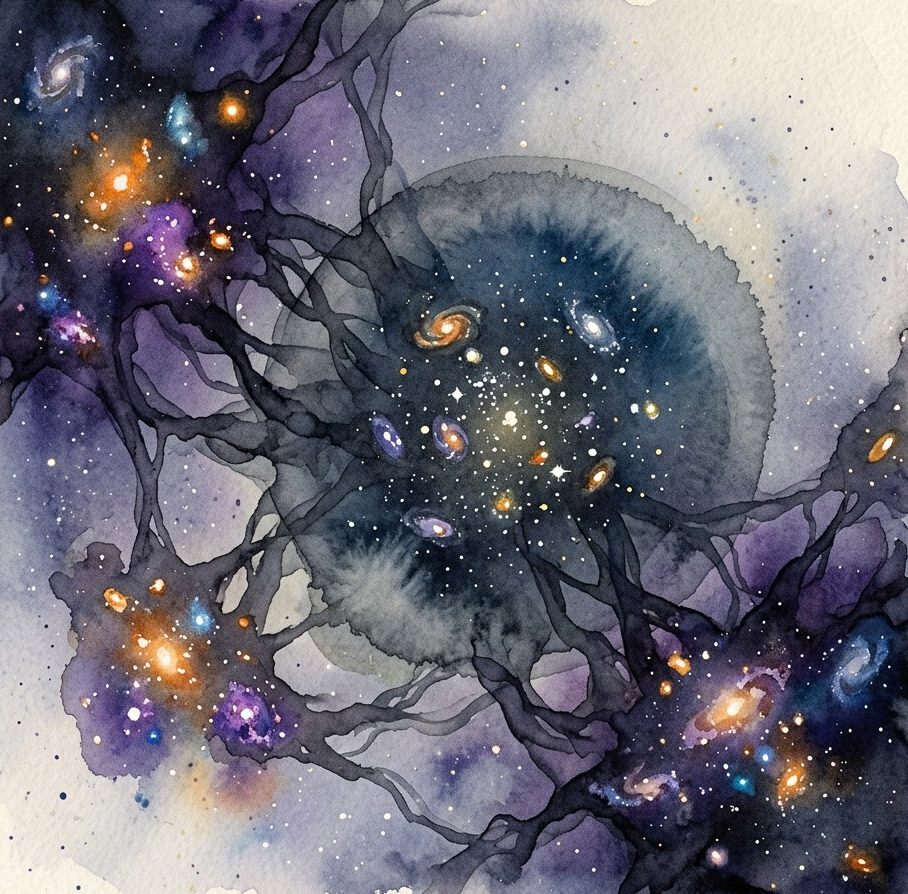
Imagine something is around you. You cannot see it, you cannot touch it, yet somehow, it is just there. Something that exists beyond the reach of your senses, silently occupying the space around you. What if the universe is filled with something we have never truly seen, something that has been there all along, shaping the cosmos in ways we are only beginning to understand?
Sounds like something out of science fiction, doesn’t it?
But it isn’t fiction. It is one of the greatest mysteries of our universe.
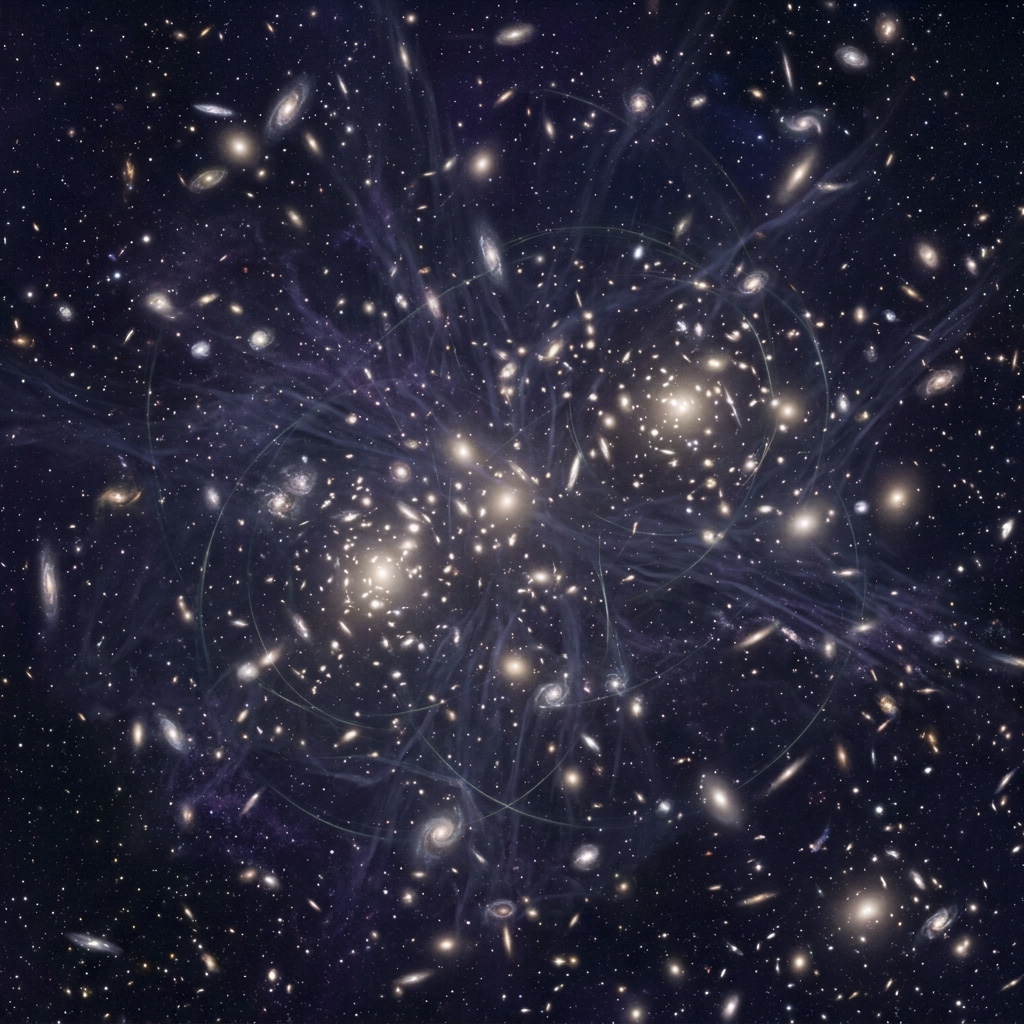
To understand dark matter, we must first understand something fascinating about the universe: not everything that exists can be seen.
When we look up at the night sky, we see stars shining brightly, planets moving through space, galaxies stretching across unimaginable distances, and enormous clouds of gas and dust. These are all forms of matter that interact with light, allowing us to observe them through our naked eyes or telescopes.
But what if these visible objects are only a small fraction of everything that exists?
Dark matter is a mysterious form of matter that does not emit, absorb, or reflect light in any way that we can currently detect. This means it cannot be observed directly through ordinary telescopes or naked eyes. Unlike the stars that illuminate the universe, dark matter remains invisible to us.
However, invisibility does not mean non-existence.
Scientists believe dark matter exists because of the gravitational effects it produces on the objects around it. Although we cannot see dark matter itself, we can observe how its gravity influences stars, galaxies, and even the bending of light travelling through space.
Think of it this way: imagine watching leaves move in the wind. You cannot see the wind itself, but you can observe its effects. Similarly, scientists cannot directly see dark matter, yet they can study the gravitational influence it appears to have on the universe.
But there is one important difference: wind is something we already understand, while dark matter remains one of the biggest unanswered questions in modern physics.
Here comes the most intriguing part.
We know that ordinary matter—the matter that makes up our bodies, the Earth, stars, and planets—is composed of atoms. Atoms contain particles such as protons, neutrons, and electrons.
Dark matter, however, does not appear to behave like ordinary matter.
Scientists have proposed several possibilities regarding its composition. It could consist of undiscovered particles that interact very weakly with ordinary matter. Some theoretical candidates include WIMPs (Weakly Interacting Massive Particles) and axions.
Yet, despite decades of research, no dark matter particle has been conclusively identified.
This means that we currently know much more about what dark matter does than what dark matter is.
And perhaps that is what makes it so fascinating: we have evidence of its existence, but its identity remains hidden.
Axions are hypothetical elementary particles that scientists believe could potentially make up dark matter.
They were originally proposed to solve a problem in particle physics called the strong CP problem. Later, scientists discovered that axions could also possess properties suitable for explaining dark matter.
If axions exist, they may be incredibly light and interact very weakly with ordinary matter, making them extremely difficult to detect.
Scientists are actively searching for them using sensitive experiments and powerful magnetic fields.
But here’s the fascinating part: a particle proposed to solve one scientific mystery might also help solve another.
The universe is far stranger than it appears.
According to the standard model of cosmology, the universe’s total energy content is approximately divided into three major components:
These numbers are approximate, but they reveal something extraordinary.
The matter we can see, and touch represents only a small portion of the universe’s total contents. Most of the universe is made up of components whose fundamental nature is still not fully understood.
Dark matter alone accounts for roughly five times as much matter as ordinary matter.
Imagine looking at the universe and realizing that the galaxies, stars, and planets you admire are only a tiny fraction of its matter.
The rest is hidden from our direct vision.
And this leads us to a fascinating question:
If dark matter is invisible, how did scientists discover that it exists in the first place?
We see the universe through light. From the stars illuminating the night sky to the objects surrounding us, light allows us to explore the world beyond our reach.
But dark matter seems to follow a different set of rules.
It does not interact with light in the ways ordinary matter does. It neither shines like a star nor reflects light like a planet. This makes it nearly impossible to observe directly, even with our most powerful telescopes.
Yet its gravity leaves behind clues of its existence.
Perhaps the universe is not as empty as it appears. Perhaps we are simply unable to see everything it contains.
Dark matter is not believed to exist only in distant galaxies. Our Solar System lies within the Milky Way, which is thought to be surrounded by an enormous dark matter halo.
As the Sun travels through our galaxy, our Solar System moves through this region of space, where dark matter is believed to be present.
This means that dark matter could exist in our cosmic neighbourhood, much closer than we might imagine.
However, it is not a dark cloud or a visible layer surrounding us. Scientists believe it is spread diffusely throughout the galaxy.
And here’s something fascinating: if dark matter consists of certain types of particles, they could potentially pass through ordinary matter, including Earth, without interacting noticeably.
Something could be passing through the space we occupy, and we might never know.
Imagine standing on Earth, surrounded by everything familiar—air, light, matter, and life.
Now imagine that an invisible form of matter may also be present in the space around our planet.
Scientists estimate the local dark matter density near the Sun to be approximately 0.4 GeV/cm³, although the value is uncertain. This incredibly diffuse matter is believed to be part of the Milky Way’s dark matter halo.
But does this mean Earth is wrapped in dark matter?
Not exactly. Dark matter is not thought to form a concentrated shell around our planet. Instead, Earth moves through the galaxy’s diffuse dark matter distribution.
The idea is extraordinary: the universe’s invisible matter may not be confined to distant cosmic regions. It may exist right within our own galactic neighbourhood.
But if dark matter is so close to us, why haven’t scientists detected it directly?
Think about the world around you. We often believe that reality is limited to what we can see, touch, or experience.
But dark matter challenges that belief.
It reminds us that the universe may contain things far beyond our senses—things that influence our existence without ever making themselves visible.
We have explored its mysterious nature, its possible particles, and its presence within our galaxy. Yet, its identity remains unknown.
Perhaps one day, scientists will uncover the answer. Perhaps the discovery will completely transform our understanding of the universe.
Until then, dark matter leaves us with a thought worth carrying beyond the stars:
What if the universe we see is only a glimpse of the universe that truly exists?
1. What is dark matter?
Dark matter is a mysterious form of matter that cannot be directly observed through light but is believed to exist because of its gravitational effects.
2. Why is dark matter invisible?
Dark matter does not interact with light in the usual ways, making it invisible to conventional telescopes.
3. How much of the universe is dark matter?
Dark matter accounts for approximately 27% of the universe’s total energy content and about 85% of its total matter.
4. What is dark matter made of?
Its exact composition is unknown. Scientists propose particles such as WIMPs and axions as possible candidates.
6. Is dark matter present around Earth?
Dark matter is believed to exist in the space surrounding our Solar System as part of the Milky Way’s dark matter halo.
7. Can dark matter pass through our bodies?
If it consists of weakly interacting particles, they could pass through our bodies without noticeable interaction.
8. Can we see dark matter?
No. Dark matter has not been directly observed. Scientists study its gravitational effects instead.
9. Is dark matter the same as dark energy?
No. Dark matter helps form cosmic structures through gravity, while dark energy is associated with the accelerated expansion of the universe.
10. Has dark matter been discovered?
Its gravitational effects provide strong evidence for its existence, but its fundamental particle nature remains unconfirmed.
11. How do scientists search for dark matter?
Scientists use underground detectors, powerful telescopes, particle experiments, and sensitive instruments to search for possible dark matter signals.
12. Why is dark matter important?
Dark matter is essential to understanding how galaxies form, how the universe is structured, and how the cosmos evolved.
13. What would happen if dark matter did not exist?
Without dark matter, the formation and evolution of galaxies as we understand them would be very different.
14. What is the biggest mystery about dark matter? The biggest mystery is its identity—what it is made of and what particles, if any, are responsible for its gravitational effects.
Where can you buy books?
You can buy books at Amazon.in and Bookosmia.com

Discover a heartwarming children’s picture book about love, kindness, and friendship in Princy the Porcupine’s Hugs by Nikhila Wunnam, a beautifully illustrated kids book about emotions and empathy that helps young readers understand how to express care in meaningful ways. Princy is a lovable little porcupine who adores his friends and wants to show his affection with warm hugs. But there’s one problem, his prickly quills make hugging difficult! This charming and engaging story for toddlers and preschoolers follows Princy as he learns creative ways to express love, teaching children that kindness can be shown through thoughtful actions, gentle words, and caring gestures. Perfect as a bedtime story for kids ages 3–7, this delightful early learning picture book introduces essential concepts of emotional intelligence for children, including empathy, compassion, and social skills. Through simple storytelling and relatable situations, young readers will learn how to recognize feelings, build friendships, and express emotions in positive ways. This beautifully crafted children’s book, Published by Bookosmia, about feelings and friendship is ideal for parents, teachers, and caregivers looking for kids books about kindness, social-emotional learning books for preschoolers, and gentle parenting resources that encourage emotional growth. With its soothing tone and engaging narrative, Princy the Porcupine’s Hugs makes a perfect addition to any collection of bedtime stories, picture books for toddlers, and books that teach empathy and kindness. Whether you’re searching for a gift for young children, a classroom read-aloud book, or a meaningful story to share at bedtime, this touching tale reminds children that love doesn’t always need a hug, sometimes, the smallest acts of kindness make the biggest difference.
***
This article is published by Bookosmia, India’s #1 publisher for and by young people. Bookosmia publishes stories, books, podcasts, events, TED-Ed talks, workshops, bedtime stories and more related to kids and young adults.
Photo Credit – Royalty Free Images by Chat Gpt, Canva Ai, Magic Media, Jetpack Image editor, Gemini AI
Want to publish your articles, reviews, stories, audio stories, bedtime stories and poems ?
Did you know that children can submit audio stories to be turned into Bedtime Stories and published on Bedtime Stories – A Podcast by Bookosmia?
Write to us at sara@bookosmia.com or submit your article at the link below