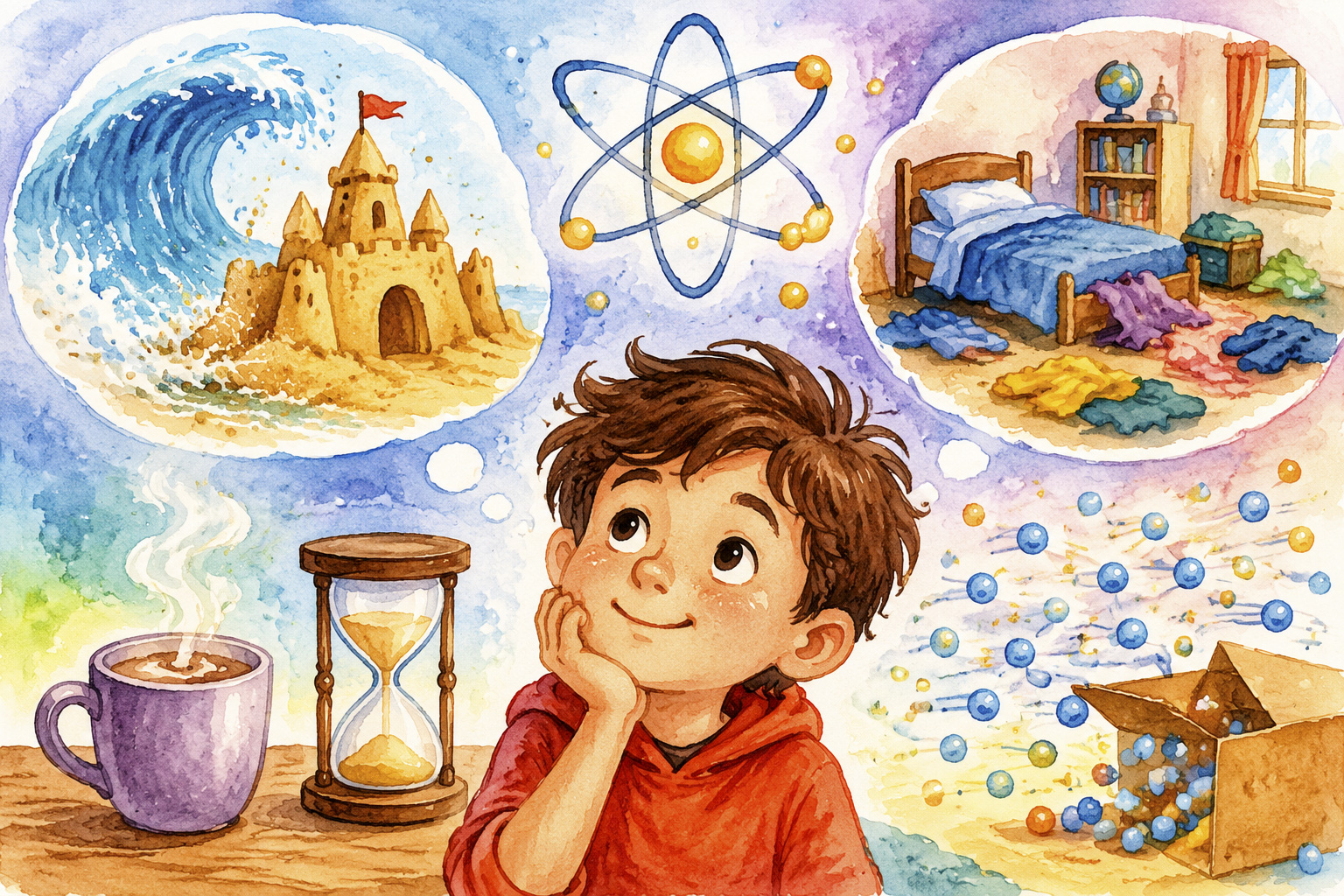
You look at the arenaceous sand castle you just built. An elegant beauty indeed…never mind it got washed away.
Ever thought why? Sure, water moved towards it but how? And why did that anomaly give it consent to do so? It’s because of entropy. It’s the measure of randomness, disorder, or the number of ways a physical system can be arranged.
Look at your room, there may be dust ambushing you right now, hiding in the cracks of your furniture or inside your unused clothes. That’s the sign of high entropy. You would need to work or burn calories just to sweep the pristine mosaic floors or you glinting clothes that hide whatever flora there might be right now!
Glance at your room after you’ve cleaned it. It’s spotless! gleaming with the clinical olfactory scent of detergent. That’s low entropy.
When something is messy like clothes hanging in different places or dust, it’s high entropy or “more randomness” but when it’s the exact opposite, a clean, organized bedroom where every trouser is stacked upon in a pragmatic manner, it’s low entropy or “less randomness”.
In entropy, chaos is triumphant towards silence. When gas molecules are placed inside a box, they have a million ways of bouncing, scattering or bunking their usual place, thus, more chaos but there is only one way to be organized, thus, less chances of low entropy. Chaos is simply inevitable.
Imagine a cold winter night. Santa’s gonna come to your house tonight! The glossy hot wheels set, a new laptop or even new toys!! You are so excited. At this moment, you are sipping hot chocolate milk, enjoying every moment of your time. But ever thought what is happening to the heat that is exuded from that milk?
Nature hates extremes. When you leave your chocolate milk out, its concentrated thermal energy or heat doesn’t stay in that exact same place—it spreads out evenly into the cooler room. Entropy is simply the measure of that energy dispersal. Once energy is completely spread out, it’s trapped and can’t do any more work.
Boltzmann’s Law is the perfect example. Let’s say there are two variables; (W) – microscopic arrangements and (S) – entropy! They are actually two sides of the same coin. Heads or tails! This law in physics tells us that more hidden arrangements mean higher entropy.
Now look at your sand castle again. It hasn’t come back to its original form yet. It’s still a wet mush. Why? Because reversing entropy is practically impossible! Entropy doesn’t just measure time; it gives time its direction. It’s why eggs shatter, sandcastles wash away, and time only moves forward.
Remember:-
Sources:-
1. What is entropy in physics?
Entropy is a physical quantity that measures how energy is dispersed in a system and how many microscopic arrangements are possible. It is often associated with disorder or randomness.
2. Why does entropy tend to increase?
Entropy tends to increase because there are generally many more ways for a system to be spread out or mixed than to remain in a specific, organized arrangement.
3. How does entropy explain why a sandcastle gets washed away?
Water breaks down the sandcastle and spreads the sand into its surroundings. The original structure is difficult to restore naturally because it requires energy and careful effort to rebuild.
4. What is the difference between high entropy and low entropy?
High entropy generally corresponds to more possible microscopic arrangements, while low entropy corresponds to fewer possible arrangements. A tidy room and a messy room can illustrate this idea, although room cleanliness is not a precise measure of thermodynamic entropy.
5. How does entropy explain why hot chocolate cools down?
Heat naturally flows from the warmer chocolate to the cooler surroundings. This spreads thermal energy and increases the total entropy of the chocolate and its surroundings.
6. What is Boltzmann’s law of entropy?
Boltzmann’s law relates entropy to the number of possible microscopic arrangements of a system. It is expressed as S = kB ln W, where S is entropy, kB is Boltzmann’s constant, and W is the number of accessible microscopic arrangements.
7. How is entropy connected to the direction of time?
The second law of thermodynamics states that the total entropy of an isolated system tends not to decrease. This helps explain why many everyday processes, such as breaking an egg or cooling a hot drink, happen naturally in one direction rather than spontaneously reversing.
8. Can entropy ever decrease?
Yes. Entropy can decrease in a particular system when energy is transferred or work is performed. For example, a refrigerator cools its interior while releasing heat into the surroundings. The total entropy of the refrigerator and its surroundings does not decrease during normal operation.
9. Why does cleaning a room require energy?
Cleaning requires physical effort and energy to collect dust, organize objects, and restore order. This is a useful analogy for entropy, although the thermodynamic entropy of a room depends on more than how tidy it looks.
10. Why is entropy important in everyday life?
Entropy helps explain why ice melts in warm surroundings, hot drinks cool down, gases spread through a room, and many natural processes are difficult to reverse. It is a fundamental concept in thermodynamics and statistical physics.
11.Where can you buy the books?
You can Buy the books at Bookosmia.com and Amazon.

Discover a heartwarming children’s picture book about love, kindness, and friendship in Princy the Porcupine’s Hugs by Nikhila Wunnam, a beautifully illustrated kids book about emotions and empathy that helps young readers understand how to express care in meaningful ways. Princy is a lovable little porcupine who adores his friends and wants to show his affection with warm hugs. But there’s one problem, his prickly quills make hugging difficult! This charming and engaging story for toddlers and preschoolers follows Princy as he learns creative ways to express love, teaching children that kindness can be shown through thoughtful actions, gentle words, and caring gestures. Perfect as a bedtime story for kids ages 3–7, this delightful early learning picture book introduces essential concepts of emotional intelligence for children, including empathy, compassion, and social skills. Through simple storytelling and relatable situations, young readers will learn how to recognize feelings, build friendships, and express emotions in positive ways. This beautifully crafted children’s book, Published by Bookosmia, about feelings and friendship is ideal for parents, teachers, and caregivers looking for kids books about kindness, social-emotional learning books for preschoolers, and gentle parenting resources that encourage emotional growth. With its soothing tone and engaging narrative, Princy the Porcupine’s Hugs makes a perfect addition to any collection of bedtime stories, picture books for toddlers, and books that teach empathy and kindness. Whether you’re searching for a gift for young children, a classroom read-aloud book, or a meaningful story to share at bedtime, this touching tale reminds children that love doesn’t always need a hug, sometimes, the smallest acts of kindness make the biggest difference.
***
This article is published by Bookosmia, India’s #1 publisher for and by young people. Bookosmia publishes stories, books, podcasts, events, TED-Ed talks, workshops, bedtime stories and more related to kids and young adults.
Photo Credit – Royalty Free Images by Chat Gpt, Canva Ai, Magic Media, Jetpack Image editor, Gemini AI
Want to publish your articles, reviews, stories, audio stories, bedtime stories and poems ?
Did you know that children can submit audio stories to be turned into Bedtime Stories and published on Bedtime Stories – A Podcast by Bookosmia?
Write to us at sara@bookosmia.com or submit your article at the link below