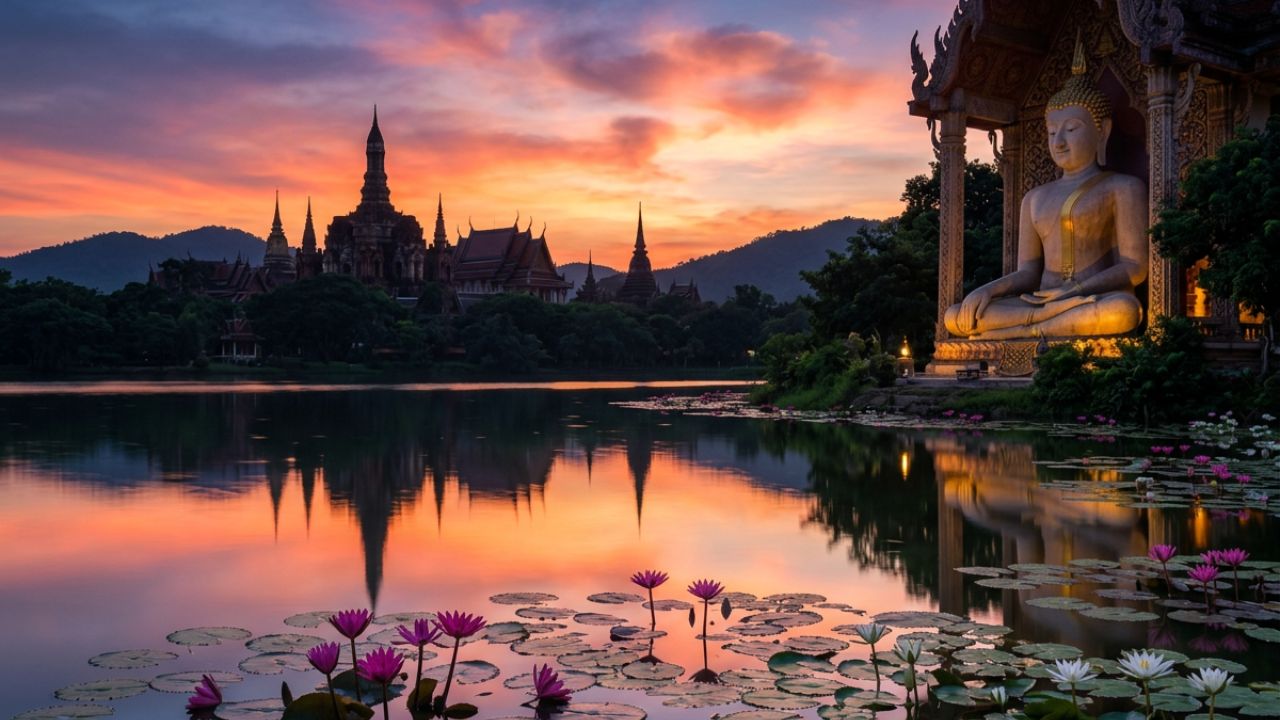
Long ago, in the kingdom of Nagavi, there lived a king named Nagarasa. He was a devoted follower of the Buddha and also a wise ruler. His kingdom was prosperous, and the people lived happily.
King Nagarasa loved building Buddhist temples in every town and village of his kingdom. In each temple, he installed a beautiful statue of the Buddha. He appointed people to take care of the temples and perform daily worship, and he granted them land and donations for their livelihood.
All this required a great deal of money. So the king collected higher and higher taxes from his people. Since the temples were being built in the name of the Buddha, the people patiently accepted the burden and paid whatever the king demanded.
One day, the king thought, “I must do something that will make my name live forever.” He decided to build the tallest statue of the Buddha in the entire world.
He spent all the wealth in the royal treasury and collected even more taxes from the people. A magnificent site was chosen, and skilled sculptors were invited from many lands to create a gigantic bronze statue of the Buddha, hundreds of feet tall.
Everyone in the kingdom said, “When this statue is completed, the whole world will look toward our kingdom. King Nagarasa’s name will be remembered forever!”
For five long years, hundreds of sculptors worked together to complete the grand statue.
When it was finally finished, the king stood before it and admired it from top to bottom. He felt proud of what he had achieved.
But something seemed wrong.
He felt that the Buddha was not smiling.
The king looked again and again from different places, yet he could not see a smile on the Buddha’s face. It troubled him deeply.
He summoned all the sculptors and asked, “The Buddha’s face must have a smile. Only then will the statue be truly beautiful. Can anything be done?”
The sculptors replied respectfully, “Your Majesty, we have used all our skill, wisdom, and experience to create this statue. We have already carved a gentle smile on the Buddha’s face. If you cannot see it, we do not know why. There is nothing more we can do.”
The king remained dissatisfied. No matter how often he looked, he still could not see the smile.
Finally, he decided to inaugurate the statue anyway.
For the grand opening, he announced that the statue would be bathed in milk. The milk produced in the royal palace was reserved for the ceremony.
On the appointed day, members of the royal family, neighboring kings, friends, and relatives gathered. Huge vessels of milk were poured over the statue.
To everyone’s surprise, not even half of the giant statue became wet.
Disappointed, the king ordered that all the milk produced in the capital city for one day should be brought for the ceremony.
The next day, every household in the capital brought their milk and poured it over the statue. Yet the entire statue was still not covered.
Seeing so much milk being wasted, an elderly minister said gently, “Your Majesty, this milk could have filled the stomachs of thousands of children.”
But the stubborn king ignored his advice.
He issued a strict order:
“Tomorrow, every drop of milk produced anywhere in the kingdom must be brought for the ceremony. No one may keep even a single drop for personal use.”
The next morning, people from every village carried milk toward the great statue.
In one small house in the capital, a woman also took the little milk her family had and set out for the ceremony. Since they had donated all their milk the previous day as well, her two little children had not had any to drink.
Today they cried, begging for milk.
The mother explained the king’s order, but she refused to give them any.
The children cried even louder.
Their grandmother quietly took the pot of milk from the mother and said, “I’ll take it to the ceremony.”
The children followed her.
As soon as they were out of sight of the house, the grandmother stopped and gave the milk to the hungry children.
They drank until they were full.
Only one small cup of milk remained.
Taking that single cup, the grandmother continued toward the ceremony.
By the time she arrived, everyone else had already poured out all the milk they had brought. Yet the enormous statue was still not completely covered.
The king sat with his head in his hands.
When the grandmother reached the entrance, the guards stopped her.
Looking at the single cup in her hands, they laughed.
“The milk from the entire kingdom wasn’t enough,” they mocked. “Do you think your one cup will make any difference? Go back!”
But the grandmother stood firm.
“I must go inside,” she said. “It is the king’s command that everyone should offer milk. If you stop me, I shall complain to the king himself.”
The argument became so loud that the king asked what was happening.
When he heard the matter, he too wondered, “What difference can one cup of milk make?”
But the elderly minister said, “Your Majesty, she has come all this way. Let her offer it.”
The king agreed.
The grandmother climbed the steps with her grandchildren and gently poured the last cup of milk over the Buddha’s head.
To everyone’s amazement, the milk flowed over the entire statue until every part of it was covered.
The crowd joyfully cried,
“Buddham Sharanam Gacchami!”
“I take refuge in the Buddha!”
The king was overjoyed.
He invited the grandmother forward, honoured her, and bowed before her.
“How did this happen?” he asked. “You must be a truly great soul. You have performed a miracle.”
The grandmother smiled and replied,
“Your Majesty, I did nothing extraordinary. I simply gave some of the milk to my hungry grandchildren and brought only the one cup that was left.”
Her simple words struck the king’s heart.
He suddenly realized:
A cup of milk given to a hungry child is greater than the grandest offering made in God’s name.
He understood his mistake.
The king bowed respectfully to the grandmother, for she had opened his eyes.
Then he turned toward the Buddha, prayed for forgiveness, and asked for the wisdom to do what was truly right.
As he looked up…
This time, he saw a gentle smile on the Buddha’s face.
The sculptors had been right all along.
“The smile was always there,” the king thought. “I simply wasn’t worthy of seeing it.”
Yes, it was never the Buddha’s face that needed to change.
It was the king’s heart.
And now, it had.

What is the moral of the story?
The story teaches that compassion and kindness toward people are more valuable than grand displays of devotion or wealth. Helping those in need is the greatest act of worship.
Why did King Nagarasa build the giant Buddha statue?
King Nagarasa wanted to create something so magnificent that his name would be remembered forever. He believed the world’s tallest Buddha statue would bring him lasting fame.
Why couldn’t the king see the Buddha’s smile at first?
The king’s heart was filled with pride and attachment to fame. Only after realizing the importance of compassion did he become worthy of seeing the gentle smile that had always been there.
Why was the grandmother’s cup of milk special?
Before offering the remaining milk, she fed her hungry grandchildren. Her offering came from love, kindness, and selflessness, making it more meaningful than all the milk collected from the kingdom.
What mistake did King Nagarasa realize?
He realized that collecting heavy taxes and wasting food in the name of religion was wrong. Caring for hungry people is more important than making lavish offerings.
What role did the elderly minister play in the story?
The minister reminded the king that the milk could have fed thousands of hungry children and later encouraged him to allow the grandmother to make her offering.
Why did the guards laugh at the grandmother?
They believed that one small cup of milk could not possibly make any difference when all the milk from the kingdom had already failed to cover the statue.
Was the covering of the statue with one cup of milk a miracle?
The story presents it as a symbolic miracle that highlights the power of compassion, sincerity, and pure intentions over material offerings.
What message does the story give about true devotion?
True devotion is shown through kindness, generosity, and helping others—not through expensive rituals or impressive monuments.What can children learn from this story?
Children learn that sharing, caring for others, and doing the right thing with a kind heart are far more important than seeking praise or recognition.
Why did the people continue paying high taxes?
They believed the temples and statues were being built in the name of the Buddha, so they patiently accepted the burden despite the hardship.
What is the significance of the ending?
The ending shows that real transformation happens within. Once the king’s heart changed, he could finally see the Buddha’s smile, symbolizing wisdom, humility, and compassion.
Where can you buy the books?
You can buy the books at Bookosmia and Amazon.
https://www.amazon.in/dp/816855552X
Voices of Play: A National Play Manifesto By Children, Of Children and For Every Caring Adult is a Bachpan Manao Collaboration by REACH India Collective, Shiksharth, and EkStep Foundation. Published by Bookosmia. Contributors: Deepika Mogilishetty, Ashish Shrivastava, Archana Mohan, Keren Sam, Samyuktha Udupa. Made possible by 22 partner organisations who captured the voices of over 4,000 children across 10 states. Does Play have a voice? What does Voices of Play mean? Across ten states and shaped by over 4,000 children, Voices of Play is a joyful window into the world of play told by children themselves. Brought to life with the support of 22 organisations, achored by Ek Step Foundation’s Bachpan Manao program, it gathers stories, games, and memories from anganwadis, community spaces, preschools, and classrooms—capturing a rich tapestry of childhoods and the worlds of play around us we may have never noticed before. With artwork recreated from children’s own drawings and moments captured from the field, this book, published proudly by Bookosmia (smell of books) is made with children, not just about them. Built on their trust, it celebrates play as imagination, memory, and a language that belongs to every child.

This article is published by Bookosmia, India’s #1 publisher for and by young people. Bookosmia publishes stories, books, podcasts, events, TED-Ed talks, workshops, bedtime stories and more related to kids and young adults.
Photo Credit – AI generated images from Chat GPT and Magic Media from Canva .
Want to publish your articles, reviews, stories, audio stories, bedtime stories and poems ?
Did you know that children can submit audio stories to be turned into Bedtime Stories and published on Bedtime Stories – A Podcast by Bookosmia?
Write to us at sara@bookosmia.com or submit your article at the link below
Get Published