A Bookworm’s Haven
Until a while ago, I thought this was just another boring old quote. Only when I became an avid reader myself did I realise just how powerful and accurate this simple 5-letter sentence is. Books are indeed a window into another world.
Isn’t it amazing how one can enjoy a one-week holiday’s worth of fun on 200 pages of paper without even moving an inch? And I am not talking about fiction books only; this applies to all fiction and non-fiction books. While fiction books weave intricate worlds that transport us to utopian lands of fantasy, friendship, romance, and science fiction, non-fiction books allow us to interpret and understand our world through perspectives other than our own.
Since I am a devout bookworm who has always preferred hard copies over ebooks, it is strange to admit that my first trip to a bookstore took place only a few weeks ago.
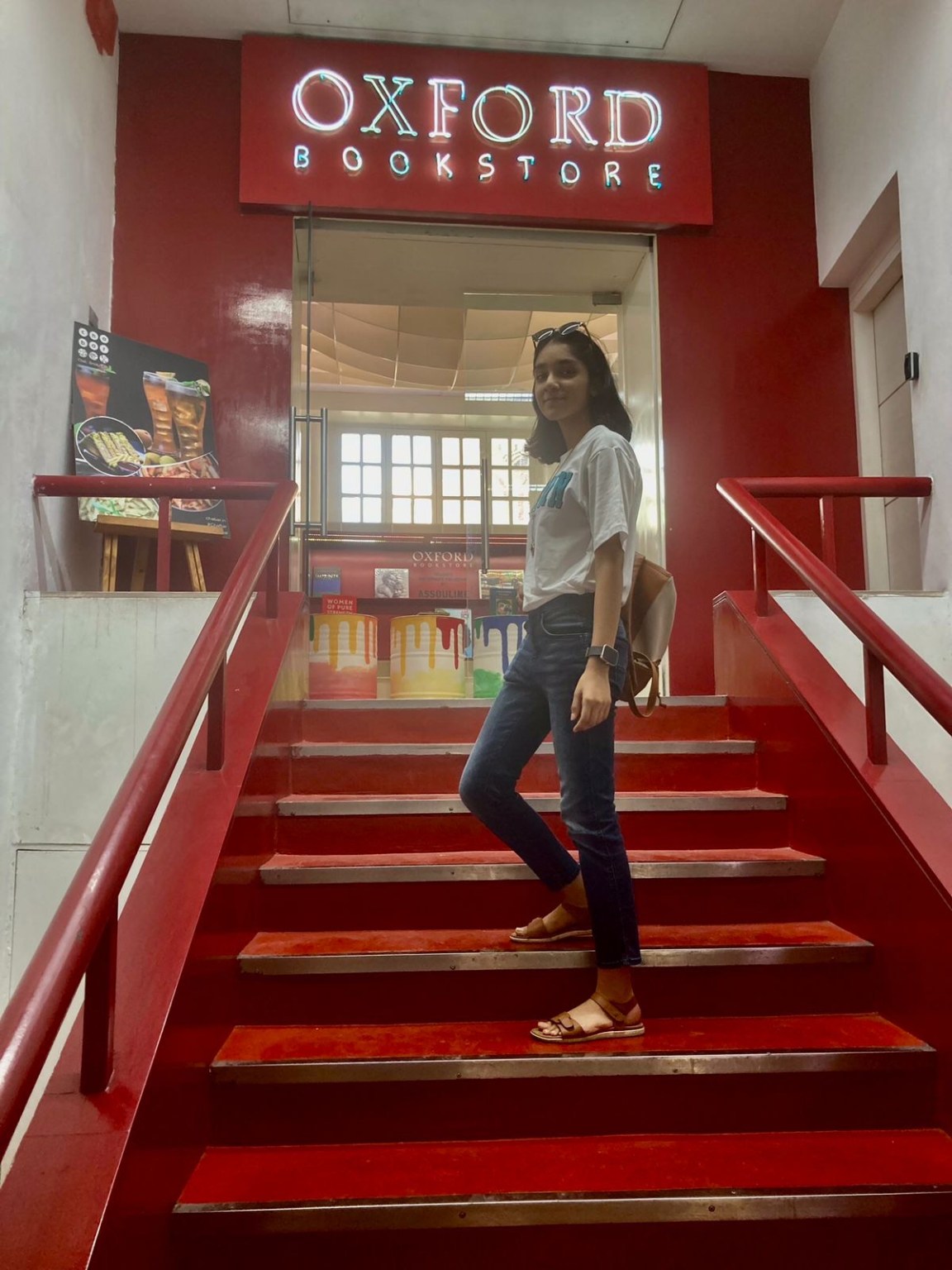
Oxford Bookstore is by no means a quaint little bookstore nestled in the nook of some old alley. It is a well-known meeting point in Connaught Place, Delhi, where readers connect with their beloved books and fellow bookworms. Upon entering the bookstore, a strong aroma greeted me—a mixture of the scents of coffee and cakes from the adjoining cafe area and the sweet smell of books.

My mother, my most trusted patron who funds all my book adventures, and I were impressed by the display that welcomed us at the entrance. On a round table, some books were arranged in an orderly fashion, with the fairy lights hanging above them illuminating the whole display.
As we entered the depths of the unexplored world of books (the bookstore), the shelves lined with books looked no less appealing to me than the walls of a candy house that looked appealing to Hansel and Gretel. My inner bookworm jumped in joy and after asking my mother for permission, I put on my captain’s hat and began navigating the vast waters of the bookstore. My face lit up with glee at seeing such a large amount of books concentrated in one place. I felt as though the whole of the Alexandrian library lay before me. My fingers traced the spines of the book, gaze passing over the colourful titles and covers. Haruki Murakami, Yuval Noah Harari, Shashi Tharoor, Agatha Christie, Virginia Woolf, Jane Austen- authors of all eras, you name it, and they probably have it.

Honestly, it was hard to pick books to buy because taking a book off the shelf felt like I was tainting the beauty of the bookstore by disassembling their collection. However, it was just too tempting to flip through the books from my favourite authors and place them in my shopping bag. While my mother browsed through the non-fiction and self-help section, I wandered through the fiction and Indian Authors section, where unknown characters from epics, novels, and comics awaited me.
I’ll take a moment to cut through the fascinating account of my first bookstore trip and briefly talk about my favourite book genres, favourite authors, and some good reading habits.
Contrary to the opinions of my friends, who say I’ve always had my head buried in books, I started liking reading at the age of 9. I started reading not for pleasure but to enhance my vocabulary. Even though I was proficient in English as an academic subject, I felt inferior to orators whose vocabulary was rich and whose sentences flowed like streamwater. When I read somewhere that reading was the best way to enhance your vocabulary, I immediately grabbed a few books and applied myself to reading books. In time, this activity, which used to be driven by the desire to be a good orator and sharpen my sentences, became a hobby that gave me pleasure and joy.
I started with authors like J.K. Rowling and Enid Blyton, who opened the doors to the world of fiction with their simple yet enchanting words. Slowly working my way through the diverse world of fantasy, I was thrown into the world of non-fiction and philosophy when I read Yuval Noah Harari’s famous trilogy, including the famous Homo sapiens. Then, before I knew it, I was being pulled into the world of gothic fiction and classics by the eloquent writings of Jane Austen, Louisa May Alcott, Oscar Wilde, the Brontë sisters, and Charles Dickens. As a reader, I believe it is good to get out of your comfort zone and explore other lines of work different from the ones you usually enjoy with a good cup of coffee. Reading a variety of books not only enhances your knowledge and vocabulary but also gives you a sense of how books of other genres are written and structured.
As much as I know how much we all love the wonderful world of fiction, unlike my younger self, please do not shy away from non-fiction and self-help books. Not all of them are boring or hard to read, and many of the modern social philosophy, biography, history, and self-help authors have started writing their books in a way that caters to younger audiences.
Books like 21 Lessons for the 21st Century by Yuval Noah Harari, Ikigai by Francesc Miralles and Hector Garcia, and Whose Samosa Is It Anyway? by Sonal Ved are some of my favourites and excellent examples of easy-to-read books packed with knowledge.
Many of my friends are intimidated by the archaic wording of classics and Romantic-era literature, and while I admit that Emily Bront’s Wuthering Heights cannot be read without referring to the internet for simplification, I believe that the genres of gothic fiction and classics are unmatched in the variety of their plots. Gothic fiction books and classics are a rollercoaster; some plots have made my heart melt with the sheer warmth that the scenes portray, while others, which have more tragic endings, have forced tears into my eyes. Still, my favourites—Little Women by Louisa May Alcott, Jane Eyre by Charlotte Bront, Northanger Abbey by Jane Austen, Anna Karenina by Leo Tolstoy, and The Picture of Dorian Grey by Oscar Wilde—are must-reads, according to me.
Another thing I’d like to emphasise is that it is not necessary to read two hours a day or finish a book in a day. Reading is not a time-bound activity. ‘A page a day’ is the mantra I go by whenever my busy schedule is stopping me from learning what happens next in my current reads.
I thank the readers who bore my little ramble till here as I resume my account of my visit to the Oxford Bookstore.
After much contemplation and deliberation on which books to buy, I settled on the following titles: The Secret History by Donna Tart, Orlando by Virginia Woolf, Dead Man’s Folly and Black Coffee by Agatha Christie, Waiting for Godot by Samuel Beckett, and An Era of Darkness by Shashi Tharoor. My patron (my loving mom) was gracious enough to pay for my books and even brought me a wonderful scented candle—just what I needed to create this year’s perfect aesthetic October evenings.